

It has almost been 3 weeks since Elon Musk’s SpaceX launched Starship for the 4th time from its Starbase, Texas launch site.
This specific launch is known as Starship Flight 4 or Integrated Flight 4 (IFT-4). When a 1st-stage Starship is mounted on a Super Heavy rocket booster, “Integrated” or “Fully Integrated”.
Flight 4 of Starship was even a bigger success compared to Flight 3 and Flight 2 launches because the events of this flight happened exactly as they were intended. One of the goals of Flight 4 was to make a soft splashdown landing of both the 1st stage (Ship 29) and 2nd stage (Booster 11) in the ocean.
Luckily, both Flight 4 Booster 11 and Ship 29 splashed down in the Gulf of Mexico and the Indian Ocean respectively. This was the end goal for Starship’s 4th test flight that SpaceX achieved with the utmost success.
The next day of the Flight 4 launch, SpaceX released stunning footage of the landing of the Super Heavy Booster 11 in the Gulf of Mexico. This footage was caught by one of the SpaceX drone ships present at the location of the soft splashdown landing of Booster 11.
The most interesting part of the video footage above is the last moments which are caught by an external camera mounted on the Booster 11. The Flight 4 Starship rocket lands on the water vertically. Raptor engines on the booster successfully ignited a landing burn. SpaceX used the combination of the movement of forward grid fins and engine boost to give the Starship rocket booster a vertical landing posture.
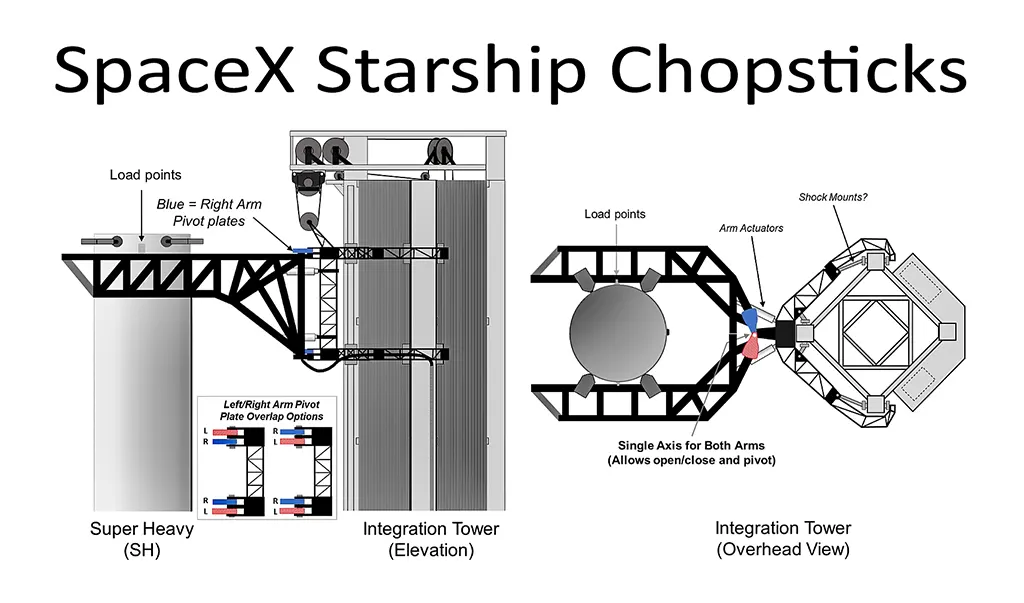
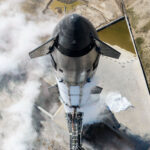
This is the beginning of what we have seen in only animated videos for the past few years — Starship and Super Heavy getting caught by the launch tower arms. These Starship launch tower arms are also known as “Chopsticks”.
Aside from stacking Starships onto Super Heavy boosters, the launch integration tower (Mechazilla) is designed to catch both the ships and rockets on landing using its Chopsticks. After the Flight 4 successful soft landings in water, SpaceX CEO Elon Musk thinks that it’s time to test the function of these landing catch arms.
“Starship booster makes soft landing in water, next landing will be caught by the tower arms,” Musk posted on his social media platform X (formerly Twitter).
If SpaceX successfully catches Super Heavy on its landing in the next Flight 5 test, it will be by far the biggest milestone they would achieve in terms of rocket and Starship reusability. Musk has iterated several times that with reusability, the cost of flights to space, Moon, and Mars cannot be reduced.
Reusability also ensures consistent flights with minimum delay between Starship launches in the future. SpaceX has already proven this phenomenon with the Falcon 9 rockets. Elon Musk’s spaceflight company will be able to repeat this success with Starship? The Starshipo Flight 5 launch will give us a solid answer. Stay tuned for the news and updates.
Stay tuned for future updates on Starship and SpaceX. Follow us on:
Google News | X (Twitter) | Flipboard | WhatsApp Channel | RSS (Feedly).
Related SpaceX Starship News
- Flight 15 catch, Starlink V3, SI ($1T revenue): Key takeaways from Elon Musk’s SpaceX (SPCX) Q3 2026 Earnings Call
- Elon Musk to give a share of SpaceX (SPCX) to every American child, President Trump praises the act, more

- Starship 40 joins three other ships inside SpaceX’s Megabay at Starbase, it’s time for some serious data collection
- Flight 13 Starship 40 returns home to Starbase, Texas, after months at sea
- SpaceX deployed 26 terabits per second of Starlink V3 bandwidth in a single Starship launch (Flight 14)
- Watch Flight 14 Starship launch live stream recordings and read the live updates archive


. Elon Musk says Flight 5 booster will be caught by launch towner arms (Chopsticks).)