

American shipping and logistics giant DHL shares the results of adding a Tesla Semi to its fleet in Livemore, California. The shipping company aims to reduce estimated CO₂ emissions to 29 million metric tons by 2030 and net zero by 2050.
The electrification of its fleet of various trucks is needed to achieve such an aggressive sustainability goal. In the category of class-8 semi-trucks, there was a certain choice, the Tesla Semi.
DHL tested the Tesla Semi for a considerable time for long-haul operations with loads of up to 75,000 pounds (34 metric tons). Interestingly, DHL got almost the same level of efficiency as Uber Freight reported in September, i.e., 1.72 kWh per mile.
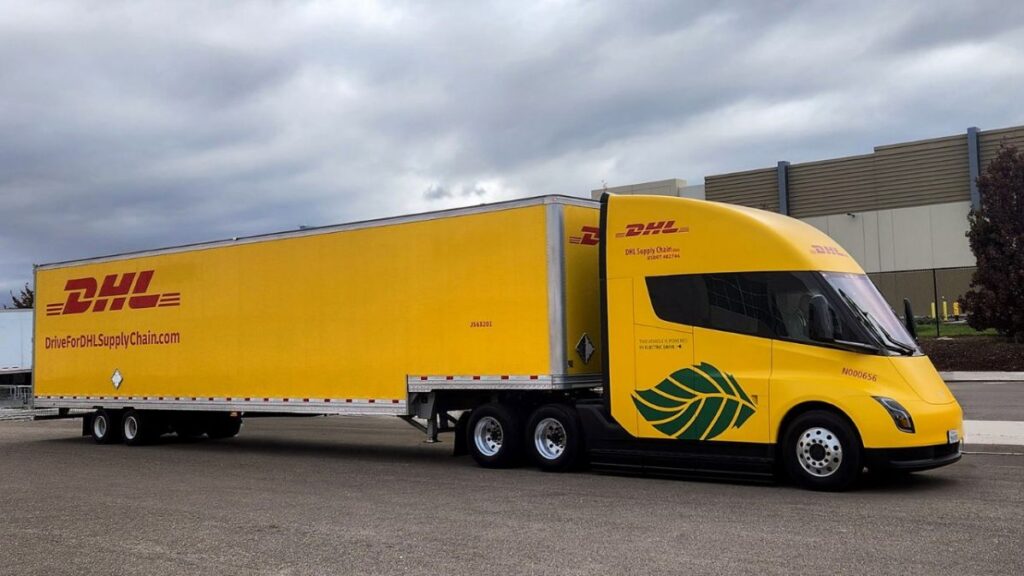
DHL’s official press release mentions some interesting specifications related to the range, charging, and efficiency of the Tesla Semi.
For example, for a 100-mile daily trip (weekdays only), the Tesla Semi only needs to be charged once a week. Tesla’s electric semi-truck’s long-range version has a 500-mile range, and that’s pretty much enough for most long-haul needs.
The Tesla Semi joins DHL’s operations following a successful pilot in Livermore, Calif., where the truck covered over 3,000 miles (5,000 km) of regular routes. During testing, the all-electric truck demonstrated outstanding efficiency, averaging 1.72 kWh per mile while hauling a gross combined weight of 75,000 pounds (34 metric tons) over a 390-mile (625 km) long-haul route.
Now operating from its new home in Central California, the truck is travelling approximately 100 miles per day, requires charging about once per week, and offers a range of up to 500 miles fully loaded. Additionally, it is projected to reduce greenhouse gas emissions by 50 metric tons annually.
Last year, in a presentation to the IAA, Tesla Semi Program Manager Dan Priestly confirmed that the electric truck drove 1,700 km (1,056 miles) in 24 hours. This is possible if a Tesla Semi is charged multiple times on its journey.
Tesla’s Semi fleet had driven 7.5 million miles till September last year. During the last year, Tesla and customer-owned Semis have accumulated more considerably larger number of miles, which means more data and improvements before production starts in 2026.
Dan posted on LinkedIn, saying:
DHL has been a great partner to work with! We are excited to support their deployment in North America, and their experience as a trusted logistics provider will help us make the product even better for future global markets.
DHL was one of the earliest reservation holders and reserved 10 Tesla Semi-trucks in 2017, just after it was unveiled by Elon Musk. The logistics company stayed committed through the years as Tesla improved the EV technology for the Semi.
However, in the latest update, DHL did not reveal how many trucks they’re planning to buy from Tesla in the coming years. This latest press release appears to be based on extensive tests using a single truck for long-haul trips.
Tesla just recently unveiled a design-refreshed Semi that follows in the updated design language of the Cybertruck and the new Model Y Juniper.
Tesla and DHL are going to be partners in the long run to achieve the zero-emissions goal for the logistics fleet of the company. Not just DHL, other similar companies don’t have a better choice than a Tesla Semi for this purpose, at least in North America right now.
Stay tuned for constant Tesla updates, follow us on:
Google News | Flipboard | X (Twitter) | WhatsApp Channel | RSS (Feedly).
Related Tesla Semi News
- Tesla Semi seen after winter testing, factory completion soon, first Megacharger opens in LA

- Tesla adds 60 planned locations to the Semi’s US Mecharger map, get the complete list

- Watch the Tesla Semi peak charging at 1.2 Megawatts

- DHL shares Tesla Semi’s efficiency and range after long-haul full load testing

- 2026 Tesla Semi: new design, production timeline, specifications, comparison to legacy generation

- Uber Freight chooses Tesla Semi for its Dedicated EV Fleet Accelerator Program




Long distance – 100 miles a day… ask real truckers what is mileage a day to make a living?