
Kennedy Space Center, Cape Canaveral Space Port Sation, Florida — SpaceX made history again by sending a record number of 143 satellites on a single mission to the lower Earth orbit yesterday. The record was previously held by the Indian Space Research Organisation (ISRO) with 103 satellites on a single launch.
Among these were 10 SpaceX Starlink satellites that are deployed to the Polar Orbit (see animation below for explanation). This will make high-speed internet available in the most remote polar locations of our planet.
The SmallSat rideshare program by SpaceX enables customers in launching their satellites to low Earth orbit (LEO) with a budget as low as $1M. In this dedicated launch, most of the small satellites were of SpaceX customers, in the past, SpaceX has been making space for a small number of customer satellites with the Starlink constellation satellites.

Elon Musk‘s space exploration & commercial spaceflight company has used optical laser-linking of the satellites for the first time. Musk has confirmed on Twitter that the black pipe-type objects at the end of each Starlink satellite are actually laser links. I have marked these objects in the following photo of the SmallSat satellite stack photo shared by SpaceX before the launch.
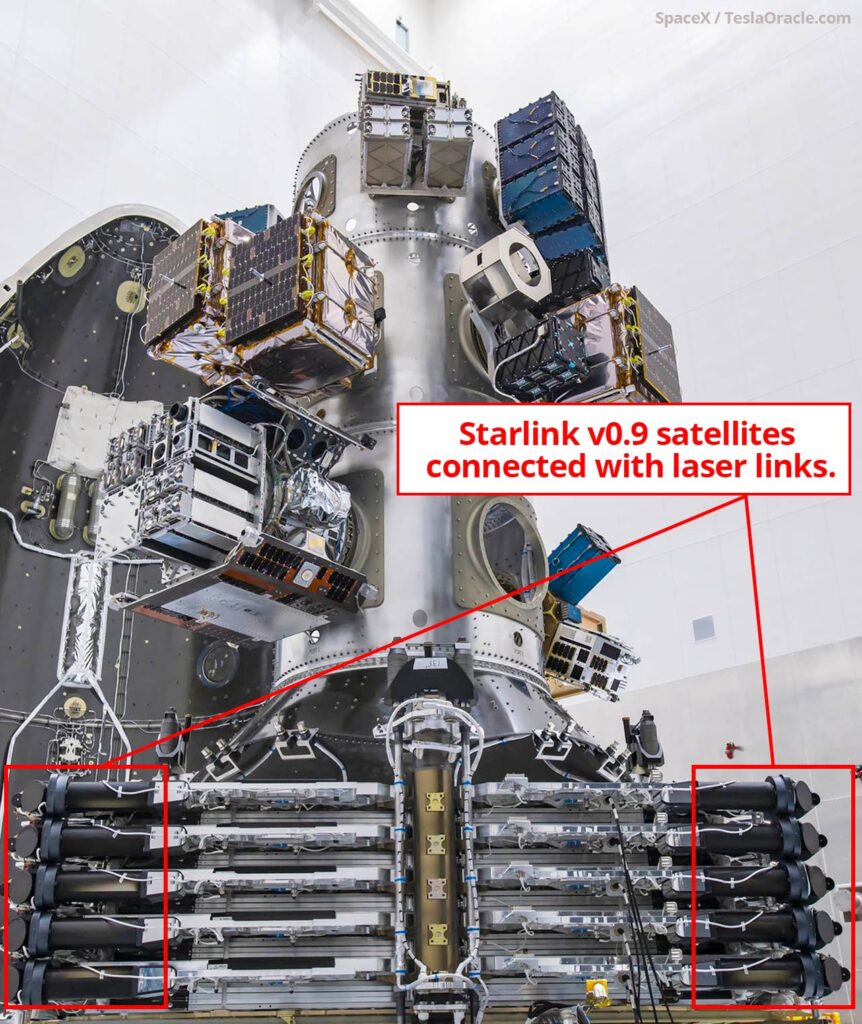
According to Musk, only the polar Starlink satellites sent to orbit this year will have laser links, all the other Starlink satellites will get laser-linking feature next year. SpaceX has given the current laser-linked satellites a version number of v0.9, Musk explained.
Why Laser Links?
Update: u/snoshy provided much-needed insight on the use of ‘laser links’ on Starlink satellites as the article made it to the HN front page.
These laser links are purely intended for satellite-to-satellite communications for Starlink. They are not (at least at this time, and for the foreseeable future) intended for ground-to-satellite communications.
The value that sat-to-sat laser links provide is that they create a low latency, high bandwidth path that stays within the Starlink satellite network. Before these 10 satellites, each Starlink satellite has only been capable of communicating directly to ground terminals (either consumer, transit or SpaceX control). For traffic that is intended to move large geographic distances (think transcontinental), this can require several hops back and forth between ground and space, or the traffic from the user terminal is exited at a node that is geared for transiting traffic and most of the data transits along with existing ground Internet links.
By performing this type of transit directly in space, and exiting at a transit node nearest the destination for the data, you greatly reduce latency. Bandwidth still might not be great, but what this does is unlocks a very financially lucrative consumer use case: low latency finance traffic and critical communications.
There are many use cases around the world where shaving even 10-20 milliseconds of latency on a data path can unlock finance and emergency capabilities, and this is a long-fought battle throughout the history of these industries. As an example, if you got a piece of news about a company in Australia, and wanted to trade on it as quickly as possible in the USA if you can beat your competitors by 10-20 milliseconds, that can mean a lot of money.
Laser comms for Starlink sats have long been planned, but have historically proven to be quite hard to get working. They also depend on a sufficient critical mass of satellites so that a given satellite actually does have another satellite within the lock to send the traffic towards.
u/snoshy via Hacker News discussion.
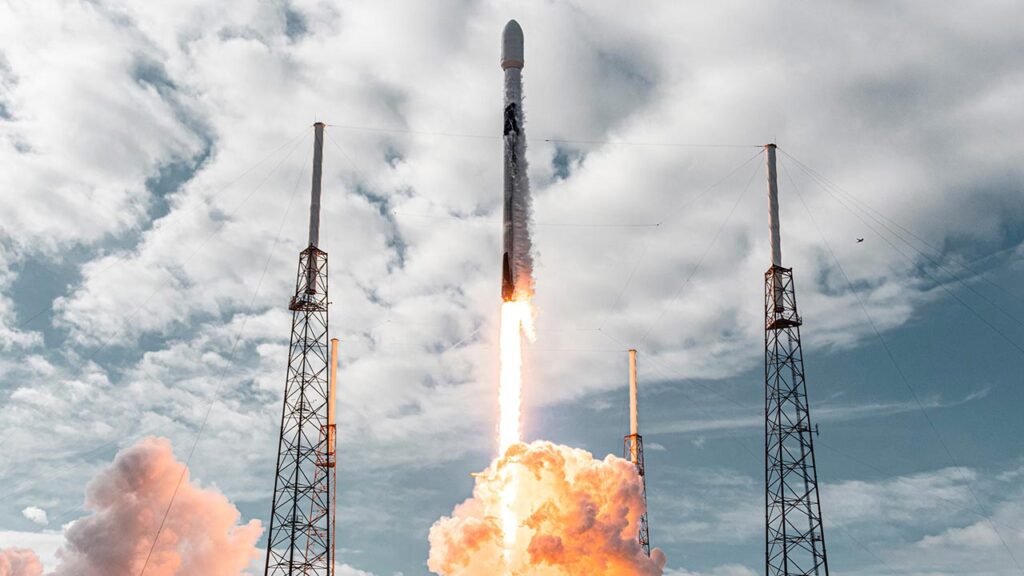
Later on, the first stage of the Falcon 9 rocket successfully landed on the Of Course I Still Love You drone ship. SpaceX posted the landing video on the company’s official Twitter account — still mesmerizes. Other space flight companies and government bodies have yet to achieve this level of precision in Rocket engineering.
Follow us for more interesting SpaceX stories & news:
Google News | Flipboard | RSS (Feedly)