Yesterday, Elon Musk’s space exploration and astronautics company SpaceX transported its next-generation first Starship V3 (Ship 39) from the production site to Massey’s Outpost at the Starbase launch site.
SpaceX moved the Flight 12-intent Starship prototype for prelaunch testing, as the company announced on X. These prelaunch tests include cryogenic pressure-proofing and, if possible, static fire tests in this attempt.
As of this writing, after around 24 hours of the Starship’s move to the Massey Outpost, SpaceX hasn’t started performing the tests. These upcoming tests are critical to the road to Starship’s 12th flight test.
But this launch and landing test is going to be different in multiple ways because SpaceX is testing the V3 Starship for the first time. Flight 11 was the last time we saw the previous generation Starship V2 launch and landing.
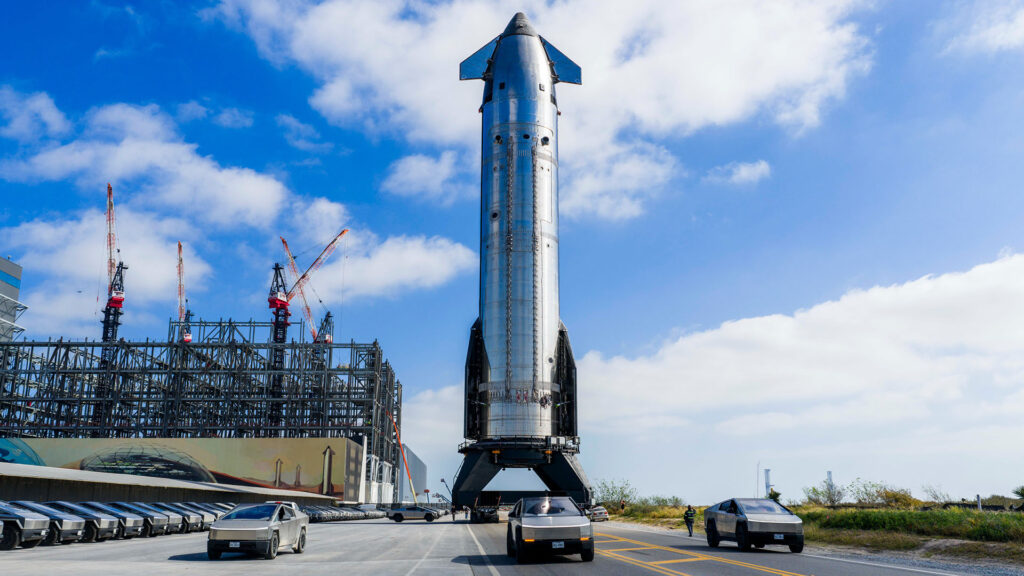
– Advertisement –The first V3 Starship (Ship 39) intended for the Flight 12 launch and landing test is escorted by a squad of Tesla Cybertrucks from the production site to the Massey’s Outpost for prelaunch testing (cryogenic pressure-proof tests). Credit: SpaceX via X.
SpaceX shared some stunning imagery of Starship 39 as it was moved to the Massey’s on the transport stand. Interestingly, we can see a three-member Cybertruck squad escorting the Starship to the testing site.
Several Cybertrucks can also be seen parked on the left. SpaceX actually acquired a Cybertruck fleet to help assist with Starbase operations last year. It also helped Tesla clear the inventory.
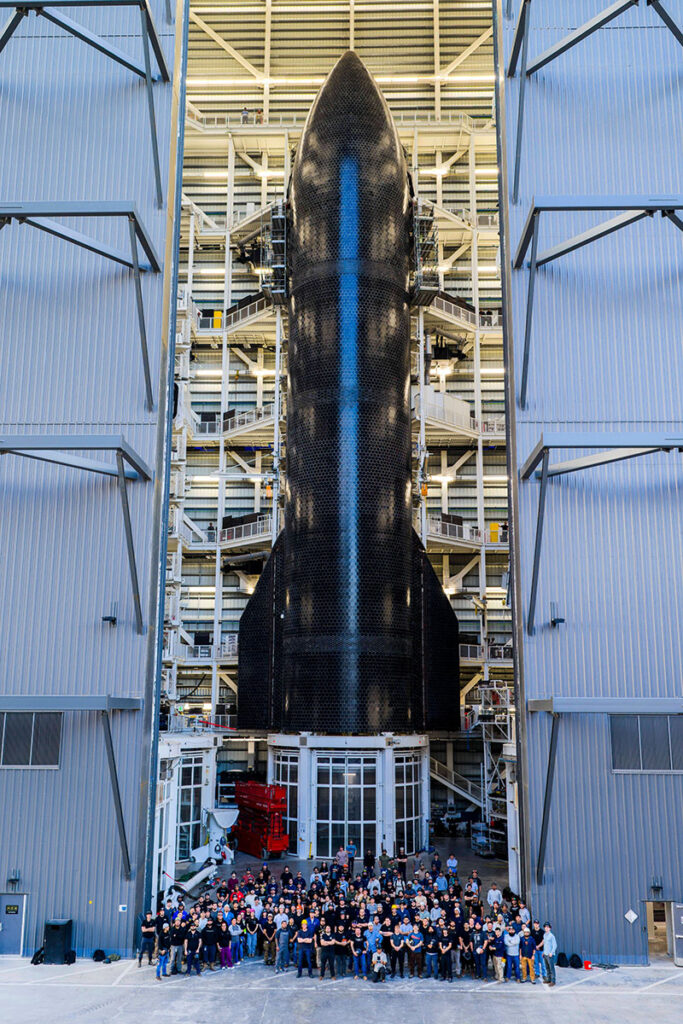
Starship 39 (first V3 prototype) parked in the Starbase Megabay hanger before leaving for the Massey’s test site. SpaceX crew takes a picture with the massive spacecraft. The belly side of the Starship is totally covered in black heat shield tiles. Credit: SpaceX via X.
– Advertisement –
As we can see in the picture above, the belly side of the first Starship V3 (Ship 39) is completely covered in heat shield tiles. These tiles are part of the Starship thermal protection system (TPS). This enables the spacecraft to bear ultra-high temperatures on atmospheric reentry.
In the upcoming Flight 12 test (IFT-12), SpaceX intends to keep all the tiles intact and test the first Starship V3’s handling of heat during the atmospheric entry burn stage and landing.
The good thing is that the FAA has given flight-safety approval for the Flight 12 Starship launch and landing test. However, since the upper stage Ship 39 still has to go through multiple tests, SpaceX hasn’t provided a solid date for Flight 12.
Since last week, SpaceX has performed two water deluge tests on Pad 2 and its flame trench. This is a critical system that is used to neutralize heat and flames caused by 33 Raptor engines during liftoff.
SpaceX needs to ensure the integrity and effectiveness of this system to prevent heat- or fire-related damage to the launch site or the launch pad during the liftoff stage. SpaceX has totally redesigned and re-engineered the new launch pad (Pad 2) to test V3 Starship prototypes.
The water deluge system is also upgraded. In addition to the water burst from the ground, SpaceX is now also going to remove any oxygen beneath the pad to further ensure fire mitigation (video below).
Pad 1 was destroyed since it was made for the previous generation Starship V2. SpaceX is now re-constructing Pad 1 as well to accommodate Starship V3 Super Heavy rocket boosters.
Video: SpaceX tests the new water deluge system under the Starship V3 launch pad (Pad 2) at Starbase, Texas.– Advertisement –
SpaceX Shifts Focus from Mars to the Moon
In a long post on X earlier this month, Elon Musk confirmed that SpaceX is shifting its focus from Mars to creating a base on the Moon first.
This is just a change in priority. Because the Mars mission is going to take way more time, and the Moon is nearer to Earth. SpaceX is now putting all its efforts into making an intermediary human base on the Moon. Mars is going to be next.
Starship is the most important spacecraft that SpaceX is going to use for its future missions to the Moon and Mars. However, the program is still in the testing phase. The final Starship that would fly to the Moon is still going to take a few years to develop.
For those unaware, SpaceX has already shifted focus to building a self-growing city on the Moon, as we can potentially achieve that in less than 10 years, whereas Mars would take 20+ years.
The mission of SpaceX remains the same: extend consciousness and life as we know it to the stars.
It is only possible to travel to Mars when the planets align every 26 months (six month trip time), whereas we can launch to the Moon every 10 days (2 day trip time). This means we can iterate much faster to complete a Moon city than a Mars city.
– Advertisement –
That said, SpaceX will also strive to build a Mars city and begin doing so in about 5 to 7 years, but the overriding priority is securing the future of civilization and the Moon is faster.
Stay tuned for future updates on Starship and SpaceX, Follow us on:
Author of more than 1500 articles on Tesla, SpaceX, and EVs. His work has been liked and tweeted by Elon Musk and other prominent influencers. You can reach him on Twitter @IqtidarAlii









 to the Massey's Outpost for cryo-proof and static fire tests (pics, video, Starbase update).)