

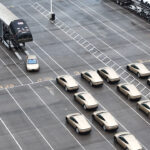
As we reported earlier this month, Tesla (TSLA) sent several Cybercab units from Giga Texas to various locations in the United States.
In addition to testing and FSD validation, the automaker plans to display some Cybercab units in multiple cities to raise awareness for its Robotaxi service and the vehicle.
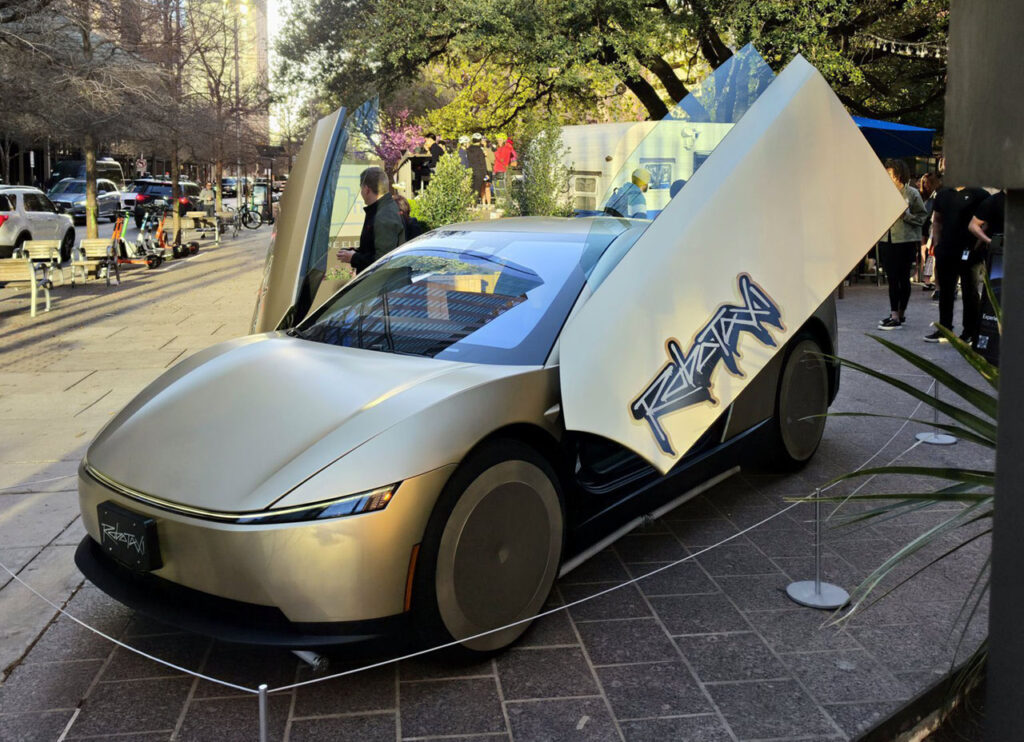
Currently, a Cybercab robotaxi unit is getting public attention at the yearly South by Southwest (SXSW) in Austin, Texas. Tesla has put large ‘Robotaxi’ decals on the doors of this early-production Cybercab EV.
This display unit reveals Cybercab information on components that were previously unavailable to the public. For example, Tesla has now added interior ambient lighting, larger Autopilot/FSD cameras, charge port location, and other improvements (see details, photos, and a first-impressions video below).
Cybercab Charge Port
The vehicle shown in the picture above is the closest to what Tesla Robotaxi service users and owners will get when it’s available to the public. Yes, Tesla plans to sell Cybercab/Model 2 units to customers in addition to use in its Robotaxi service fleet.
Interestingly, the charge port of the Cybercab is located on the left side of the rear bumper. This location is unlike the rest of the Tesla vehicles that have it on the rear fender.
Compared to what was seen previously, Tesla has applied multiple improvements to the Cybercab charging port. It now boasts a simpler design with better dust and water protection.
Interior Space
For its size, Tesla Cybercab has a long wheelbase. Since it’s made for only two passengers, the automaker has designed the cabin interior for maximum comfort and space.
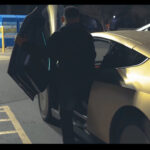
Because of the butterfly doors, entry from both sides is easier and provides much freedom of movement on entry and exit.
Seats, Leg, and Head Room
Out of Spec Reviews sat in the Cybercab Robotaxi on display in Austin, Texas. One of the hosts, who is 5’11” tall, showed that there is ample legroom left even after fully stretching his legs forward.
Headroom is also good; however, it’s not as extensive as the legroom (see video below). Tesla has not yet released official specs of the legroom and headroom of the Cybercab. These figures will be released as the vehicle goes on sale later this year.
The seats are comfortable, as observed by the reviewers. However, the true comfort reviews will arrive as the vehicle becomes available to the public later this year. Seat covers are made of shiny leather that looks a bit cheap.
The design and materials selected for the Tesla Cybercab interior are focused on high usage. As Robotaxis, these vehicles will have a high usage frequency by multiple individuals 24×7.
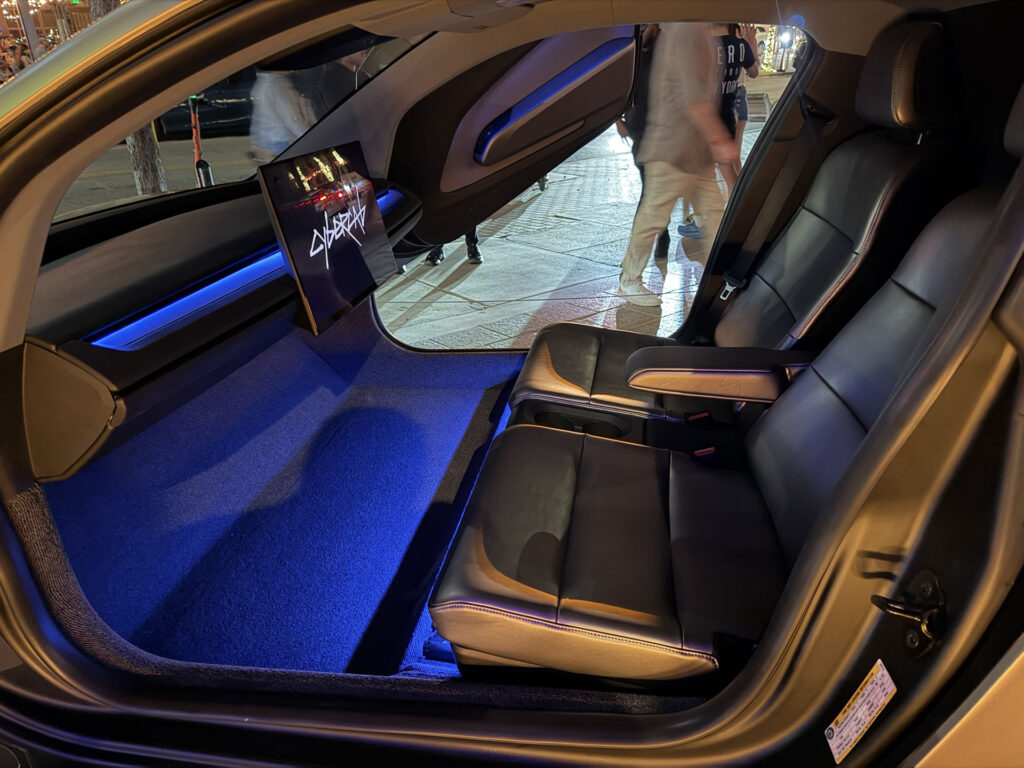
The durability of seats and flooring has more importance than a luxury feel. The carpets seen in earlier Cybercab prototypes are now replaced by a rugged material to make it more long-lasting.
Ambient Lighting and Center Display
The early prototypes of the Tesla Cybercab shown at the unveiling event did not have ambient lighting. The pilot production cars, such as the one on display in Austin, TX, have interior ambient lighting installed.
Model 3 Highland was the first Tesla car to get the ambient lighting feature. You can change the color of the ambient lights inside the cabin using the center touchscreen UI. The following picture, taken by a Tesla owner and enthusiast, shows it in blue color at night.
Cybercab’s ambient lights will enhance the nighttime ride-hailing experience. Since there will be no stress of driving the car, riders will be more focused on the car’s interior and infotainment features available on the center display.
According to people who sat in the Cybercab Robotaxi, the center touchscreen on this vehicle is larger compared to the Tesla Model Y or Model 3.
Improved Cameras
Cybercabs serve a very different purpose compared to the rest of the Tesla vehicle lineup. These cars are made for Tesla’s autonomous ride-hailing service on a larger scale.
For this purpose, the AI & tech-driven automaker has further improved Autopilot/FSD cameras in addition to the cabin and trunk cameras.
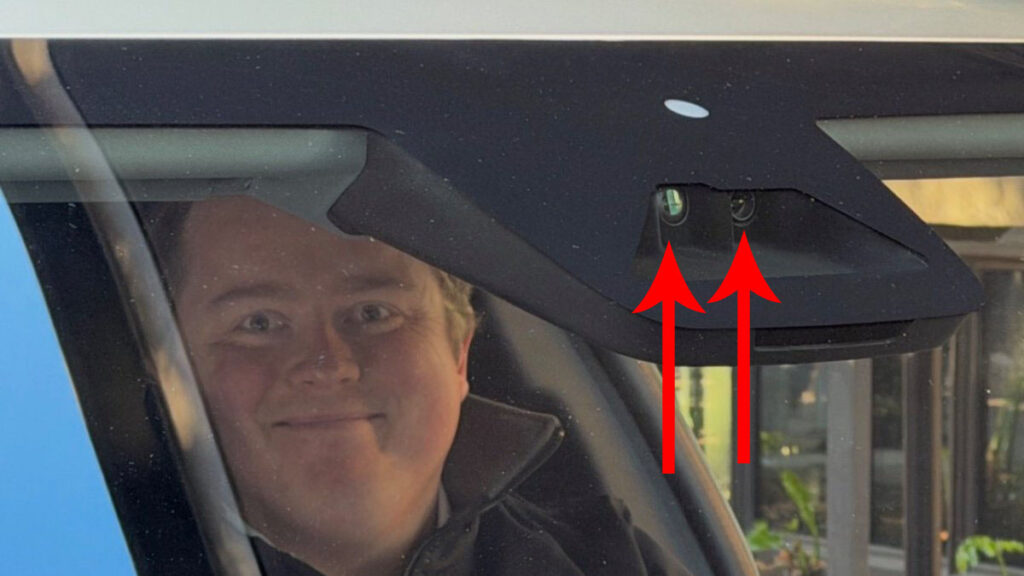
Pictures shared by Tesla owner and enthusiast David Moss show that the front-facing Autopilot cameras have larger lenses compared to other Teslas. These improved cameras will be able to capture a better AI vision of the vehicle’s environment.
A better vision and Full Self-Driving (FSD) performance ensure safety for the occupants of the Cybercab and other road users around it. Since the Cybercab has no steering wheel or brake pedal, the car needs to demonstrate maximum safety using the FSD AI system.
The cabin camera and the trunk camera are also larger compared to the rest of the Teslas. Trunk camera will make sure that ride-hailing passengers don’t forget their luggage in the car. The vehicle might generate a notification on the Tesla Robotaxi app if a person leaves something behind.
Stay tuned for constant Tesla updates, follow us on:
Google News | Flipboard | X (Twitter) | WhatsApp Channel | RSS (Feedly).
Related Cybercab News
- Tesla Cybercab first impressions: interior space, charge port, improved FSD cameras, ambient lighting, more
- Tesla sends Cybercab robotaxis from Giga Texas to testing locations across the US
- Tesla challenges UniBev’s squatting of the ‘Cybercab’ trademark with the USPTO

- Musk promises a $30K or less Cybercab delivery before 2027, Tesla (TSLA) produces the first unit at Giga Texas

- Tesla files for additional trademarks for the Cybercab in some US states: Cybercar, Cybervehicle, Robotaxi

- Tesla Cybercab butterfly door function spotted in the wild (video)


.)