

The road to Starship’s 12th Flight test with the latest V3 generation is getting even more interesting with each passing day.
Elon Musk’s SpaceX performed a propellant load test on Booster 19 on Tuesday. According to live observers at Starbase, Texas, loading propellant on the V3 Super Heavy booster was faster compared to the previous V1 and V2 generation rockets.
Starship’s V3 Super Heavy Boosters are around ~72.3 meters tall (including the new hot-staging ring). The majority of this length is dedicated to loading 3,650 tonnes of propellant.
The loading of ultra-chilled propellant (liquid oxygen and methane), providing stunning views of the Flight 12 Booster 19 at Starbase, Texas (videos below).
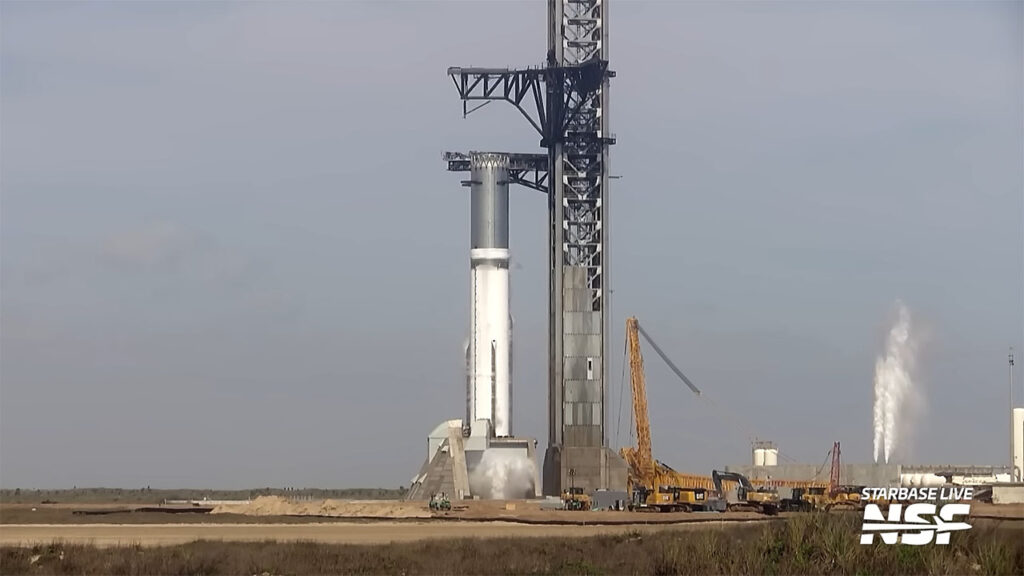
It only took around 30 minutes to fully load Booster 19 with LOX and methane. Starship V3 also marks a significant improvement in large rocket reusability. SpaceX has cut around ~5 minutes of propellant load time compared to V1/V2 Starship generation.
It’s critical to improve turnaround times to ready spaceships and rockets for reflight if rapid reusability has to be achieved.
Yesterday, SpaceX also conducted a spin prime test on Booster 19, further completing the requirements for the next launch test. This Flight 12 Super Heavy rocket has already completed its cryogenic pressure-proof tests last month.
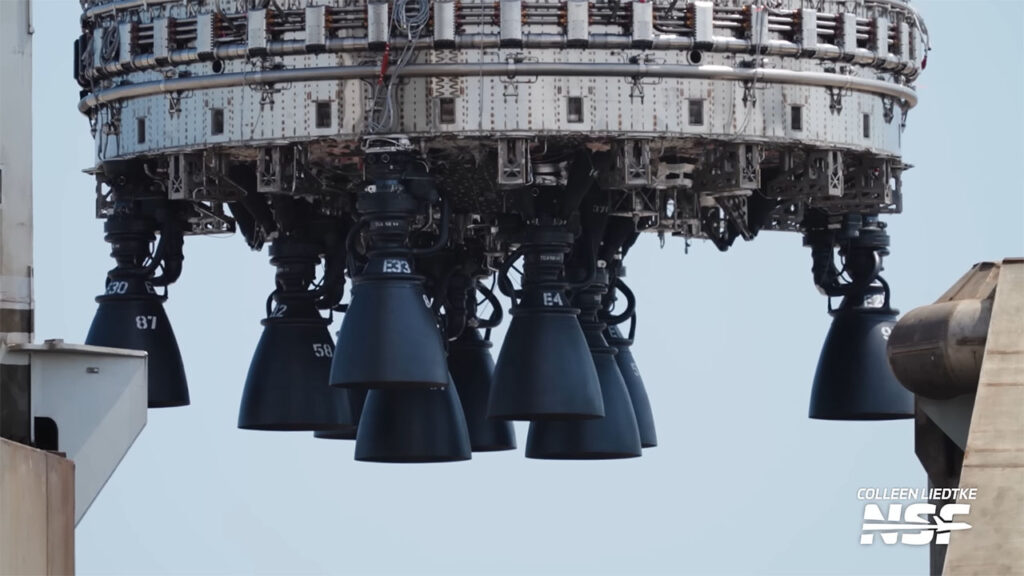
After the success of the prop-load and spin prime tests, the next step is the static fire test. Booster 19 is the first V3 Super Heavy rocket equipped with the Raptor 3 engines.
Upgraded design and the latest generation of the Raptor engine make the Flight 12 Starship launch a unique experiment, as all of this equipment hasn’t been tested before in a real flight.
Raptor 3’s significantly higher thrust and simplified design will be tested for the first time in Flight 12. However, SpaceX has installed only ten Raptor engines on Booster 19 for the current set of tests.
So, we will only witness a static fire test with 10 engines, unless SpaceX takes the rocket back to the production site and installs all 33 engines before conducting a static fire.
Booster 19 Prelaunch Test Videos
The propellant-load test of the Booster 19 Starship V3 rocket has created some stunning views at Starbase. In the following time-lapse video, NasaSpaceFlight (NSF) team has reduced the propellant load and detanking procedure into a 1-minute 18-second clip.
Prop-load can be observed externally by observing the rocket’s surface getting frosty as the propellant moves into the upper tanks (1.83 m / 6ft rings). As the detanking procedure starts, the frost moves downwards as the super-chilled fuel moves down and the structure goes back to normal temperature.
Booster 19 is on the Pad 2 launch mount, and she is looking good!
— Erik Fraser (@efraser77) March 9, 2026
🎥https://t.co/5b1GE4zkY9 @NASASpaceflight pic.twitter.com/YlhrxkLpJx
Stay tuned for future updates on Starship and SpaceX. Follow us on:
Google News | X (Twitter) | Flipboard | WhatsApp Channel | RSS (Feedly).
Related SpaceX / Starship News
- Starship Flight 14: SpaceX performs a single-engine static fire test on Ship 41, Starbase updates (videos)

- Tesla to reportedly unveil the next-gen Roadster in August, with SpaceX thrusters of-course

- Space, Connectivity, AI: Key takeaways from Elon Musk’s SpaceX Q2 2026 Earnings Call

- SpaceX (SPCX) reported revenue growth of 92% YoY and a net loss of $541 million in Q2 2026

- SpaceX to attempt Starship catch in Flight 14, as Flight 13 Ship 40 landed precisely
- Flight 13 Starship 40 is still floating in the Indian Ocean after 100 hours of its soft landing; Elon Musk shares the latest video, more



.)