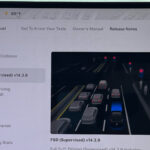
During the last week, Tesla (TSLA) rolled out FSD v14.3.1 to more users in the US and Canada. This is a point release to the main FSD v14.3 software update released earlier this month.
The Full Self-Driving (Supervised) version 14.3.1 comes with the firmware software version 2026.2.9.7 (official release notes below). This quick subversion release mostly contained bug fixes.
Since it has been around a week since FSD v14.3.1 started rolling out, multiple Tesla owners shared their experiences with this FSD update. Some of the reviews show improvements, while some users report regressions where FSD previously performed better.
FSD v14.3.1 Rollout Status
Tesla released FSD v14.3 to a very limited number of experienced beta testers. It also included influencers and YouTubers who provide constant review videos that help improve edge cases and rare traffic scenarios.
With the release of FSD v14.3.1, Tesla has expanded the user base. However, as of this writing (after 8 days of its first release), Tesla has only provided the FSD v14.3.1 update to around ~1% of the North American fleet (data sources: TeslaFi.com, stats.tessie.com).
Tesla is cautious in expanding the FSD v14.3 and its subversion releases because major pieces of the AI software have been rewritten. The automaker is closely monitoring any bugs and issues. We might witness the wide release if all goes well in the next few weeks and Tesla gains enough confidence.
FSD v14.3.1 UPL Regression
A Tesla owner posted the following video of his car taking an unprotected left turn (UPL) with FSD v14.3.1. Compared to previous versions, a regression of behavior in this specific scenario was noted.
The car took the UPL, driving too wide. FSD v14.3.1 anchored on the center line. Some other Tesla owners also reported the same behavior experienced after installing the FSD v14.3.1 update.
However, looking at Chuck Cook’s video (below), FSD v14.3.1 took the difficult unprotected left turn in Jacksonville, Florida, with precision. No regression or odd behavior of the car was observed in his extensive testing.
FSD v14.3.1 Improvements
Performance in Rain and Graupel
In one of his FSD drives, Tesla influencer Chris, aka DirtyTesla, experienced an unexpected scenario. FSD v14.3.1 was driving his car, and a sudden graupel (small soft hail) started dropping from the sky.
Graupel and hail have a different texture and effect on the windscreen compared to rain. However, FSD v14.3.1 handled it perfectly. Road reflections were also intense, blocking human vision. Wipers were constantly cleaning the FSD cameras installed behind the rear-view mirror.
Tesla’s FSD Vision AI is now capable of understanding situations like rain, snow, hail, and graupel, and it adjusts its driving behavior accordingly. The dynamic range of FSD camera sensors is also able to correctly capture these situations to give video feedback to Tesla FSD AI.
“It was very hard to see. But then with sunglasses the road was much more clear… I knew the cameras had that handled,” Christ wrote on X.
FSD 14.3.1 handles sudden graupel and blinding road reflections pic.twitter.com/WW77HJiWQW
— Dirty Tesla (@DirtyTesLa) April 19, 2026
🚨 FSD 14.31 just blew my mind in heavy rain.
— Tesla Owners Silicon Valley (@teslaownersSV) April 21, 2026
Cop swerving wildly across the road to slow traffic — cameras slicing through the downpour, FSD stays ice cool, predicts everything, and gives perfect space.
Seconds later, merging onto the on-ramp: accident scene with the cop parked… pic.twitter.com/7eJI5lmgu0
FSD 14.31 just blew my mind in heavy rain. Cop swerving wildly across the road to slow traffic — cameras slicing through the downpour, FSD stays ice cool, predicts everything, and gives perfect space. Seconds later, merging onto the on-ramp: accident scene with the cop parked right there. FSD smoothly maneuvers around, giving it safe clearance like a pro.
Heavy rain + erratic cop + obstacle avoidance in one seamless drive. This is next-level autonomy. Absolutely insane!
FSD v14.3.1 review by @Tesla Owners of Silicon Valley via X.
Handling Potholes
Popular Tesla influencer Sawyer Merritt also received the FSD v14.3.1 update on his Tesla Model Y Juniper. During his test runs, he found out that this version had improved at handling potholes and manholes.
Here’s what he said on X:
Was driving on FSD V14.3.1 today and it avoided a couple potholes/manholes. Not sure if it was just mimicking the behavior of the car in front or if it made the decision independently, but either way, FSD avoided it. Btw, love that FSD clips saved directly to your phone now include this FSD data.
Was driving on FSD V14.3.1 today and it avoided a couple potholes/manholes.
— Sawyer Merritt (@SawyerMerritt) April 18, 2026
Not sure if it was just mimicking the behavior of the car in front or if it made the decision independently, but either way, FSD avoided it.
Btw, love that FSD clips saved directly to your phone now… pic.twitter.com/tPitS1fH8p
FSD v14.3.1 (2026.2.9.7) Official Release Notes
Full Self-Driving (Supervised) v14.3.1 includes:
- Upgraded the Reinforcement Learning (RL) stage of training the FSD neural network, resulting in improvements in a wide variety of driving scenarios.
- Upgraded the neural network vision encoder, improving understanding in rare and low-visibility scenarios, strengthening 3D geometry understanding, and expanding traffic sign understanding.
- Rewrote the AI compiler and runtime from the ground up with MLIR2, resulting in 20% faster reaction time and improving model iteration speed.
- Mitigated unnecessary lane biasing and minor tailgating behaviors.
- Increased decisiveness of parking spot selection and maneuvering.
- Improved parking location pin prediction, now shown on a map with a (P) icon.
- Enhanced response to emergency vehicles, school buses, right-of-way violators, and other rare vehicles.
- Improved handling of small animals by focusing RL1 training on harder examples and adding rewards for better proactive safety.
- Improved traffic light handling at complex intersections with compound lights, curved roads, and yellow light stopping – driven by training on hard RL examples sourced from the Tesla fleet.
- Improved handling for rare and unusual objects extending, hanging, or leaning into the vehicle path by sourcing infrequent events from the fleet.
- Improved handling of temporary system degradations by maintaining control and automatically recovering without driver intervention, reducing unnecessary disengagements.
Upcoming Improvements
- Expand reasoning to all behaviors beyond destination handling.
- Add pothole avoidance.
- Improve driver monitoring system sensitivity with better eye gaze tracking, eye wear handling, and higher accuracy in variable lighting conditions.
Acronyms used:
- RL = Reinforcement Learning
- MLIR = Multi-Level Intermediate Representation (MLIR)
- FSD = Full Self-Driving
- AI = Artificial Intelligence
Stay tuned for constant Tesla updates. Follow us on:
Google News | Flipboard | X (Twitter) | WhatsApp Channel | RSS (Feedly).
Related Tesla FSD News and Reviews
- Tesla rolls out FSD v14.3 Lite (2026.38.5.1) to legacy HW3 Model S/X vehicles with Intel GPU
- Tesla FSD v14.3.12 with Halloween Update (2026.38.5) goes wide release (demo videos, release notes)

- Tesla begins the FSD v14.3.11 (2026.33.5) update rollout (first impression videos, release notes)
- Tesla FSD becomes a sales driver, millionaire realtor replaces all his company cars with Tesla EVs
- Tesla rolls out FSD v14.2 Lite: legacy Tesla owner reviews, rollout status
- Tesla rolls out FSD v14.3.9 (2026.27.6) with Automatic Collision Evasion: feature details and official release notes