After months of waiting and anticipation, Tesla finally began rolling out FSD v14.3 to non-employee Tesla vehicle owners yesterday. The firmware software version for Tesla FSD v14.3 is 2026.2.9.6 (official release notes below).
Last year, Tesla (TSLA) CEO Elon Musk called FSD v14.3 the “big piece of the puzzle”, which suggests some fundamental changes have been made to Tesla’s Full Self-Driving (FSD) AI software.
The Tesla AI team also shared release notes of FSD v14.3. These notes detail the changes and improvements in FSD v14.3 to make it significantly more responsive to traffic situations (shorter reaction time) and safer compared to the previous version, FSD v14.2.
“This update brings 20% faster reaction time to further increase safety, among many other improvements,” the Tesla AI official account posted on X.
Tesla’s FSD v14.3 software update (2026.2.9.6) has landed close to the initial rollout of Full Self-Driving in Europe. Tesla owners in Europe might directly get the latest FSD 14.3 software to begin with.
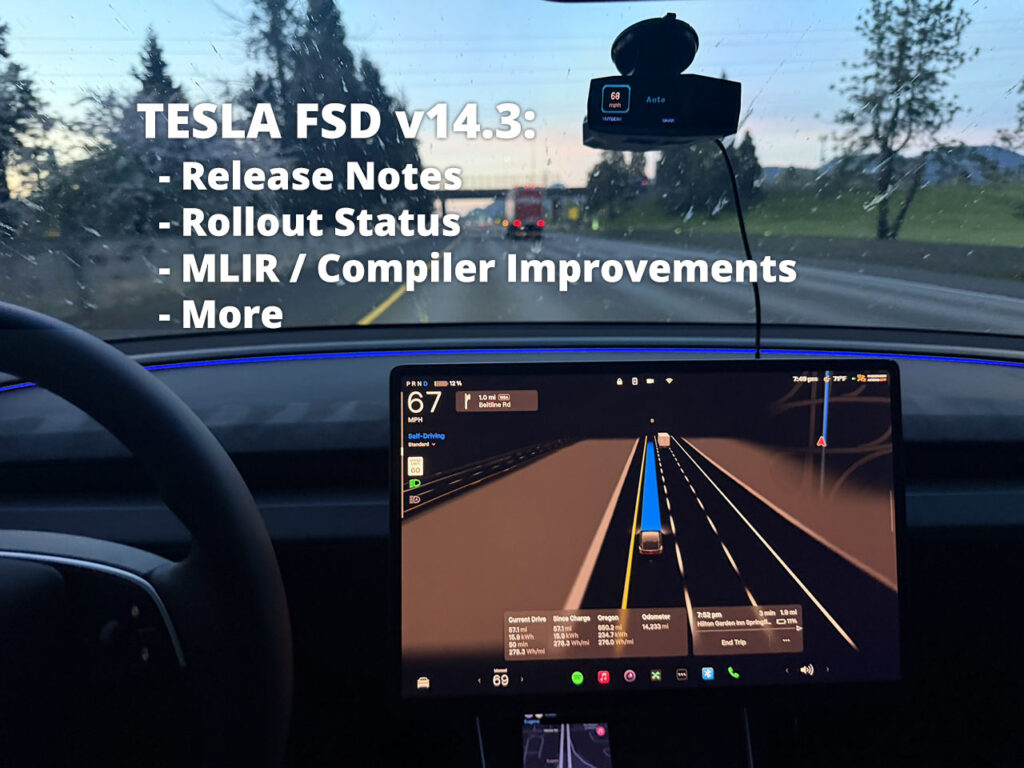
FSD v14.3 Rollout Status
On April 1st, Elon Musk announced that Tesla employees are testing FSD v14.3 internally, and the wide release would start by the end of the week. The pace at which Tesla is giving out FSD v14.3 to select owners, it can’t be called a ‘wide release’ as of yet.
In the first phase of its deployment, FSD v14.3 (2026.2.9.6) is only going out to the original FSD beta testers group. As of this writing, it has been less than 24 hours since this new FSD update started rolling out.
Looking at Tesla software tracking stats on TeslaFi.com, only four Teslas have installed the FSD v14.3 update, and one is pending. This shows that it’s strictly a limited release as of now.
Since the early access group consists mostly of influencers and YouTubers, Tesla will expand the rollout after carefully monitoring the results using data and videos shared by these users.
AI Compiler Rewrite, MLIR, Faster Reaction Time
According to the official release notes of FSD v14.3 (see below), the Tesla AI team has completely rewritten the AI compiler for this version. A compiler, as the name suggests, compiles all the code to be processed by the computer.
Interestingly, since FSD v12, Tesla got rid of manual code in favor of neural network AI. However, there is a vast array of FSD AI parameters to process. Tesla’s AI software development team rewrote the AI compiler to optimize and speed up processing of the large FSD dataset in FSD v14.3.
Along with the compiler optimization, Tesla also mentions a new term, ‘MLIR’. So, what does MLIR stand for? It’s ‘Multi-Level Intermediate Representation’. However, it needs more technical explanation by the Tesla AI team or Elon Musk, which we’re sure will come to the surface very soon.
So, the compiler and MLIR improvements result in a 20% faster reaction time. Tesla states the following in FSD v14.3 release notes:
Rewrote the AI compiler and runtime from the ground up with MLIR, resulting in 20% faster reaction time and improving model iteration speed.
FSD v14.3 (2026.2.9.6) Official Release Notes
Full Self-Driving (Supervised) v14.3 includes:
- Upgraded the Reinforcement Learning (RL) stage of training the FSD neural network, resulting in improvements in a wide variety of driving scenarios.
- Upgraded the neural network vision encoder, improving understanding in rare and low-visibility scenarios, strengthening 3D geometry understanding, and expanding traffic sign understanding.
- Rewrote the AI compiler and runtime from the ground up with MLIR2, resulting in 20% faster reaction time and improving model iteration speed.
- Mitigated unnecessary lane biasing and minor tailgating behaviors.
- Increased decisiveness of parking spot selection and maneuvering.
- Improved parking location pin prediction, now shown on a map with a (P) icon.
- Enhanced response to emergency vehicles, school buses, right-of-way violators, and other rare vehicles.
- Improved handling of small animals by focusing RL1 training on harder examples and adding rewards for better proactive safety.
- Improved traffic light handling at complex intersections with compound lights, curved roads, and yellow light stopping – driven by training on hard RL examples sourced from the Tesla fleet.
- Improved handling for rare and unusual objects extending, hanging, or leaning into the vehicle path by sourcing infrequent events from the fleet.
- Improved handling of temporary system degradations by maintaining control and automatically recovering without driver intervention, reducing unnecessary disengagements.
Upcoming Improvements
- Expand reasoning to all behaviors beyond destination handling.
- Add pothole avoidance.
- Improve driver monitoring system sensitivity with better eye gaze tracking, eye wear handling, and higher accuracy in variable lighting conditions.
Acronyms used:
- RL = Reinforcement Learning
- MLIR = Multi-Level Intermediate Representation (MLIR)
- FSD = Full Self-Driving
- AI = Artificial Intelligence
Stay tuned for constant Tesla updates. Follow us on:
Google News | Flipboard | X (Twitter) | WhatsApp Channel | RSS (Feedly).
More on Tesla FSD
- Tesla FSD becomes a sales driver, millionaire realtor replaces all his company cars with Tesla EVs
- Tesla rolls out FSD v14.2 Lite: legacy Tesla owner reviews, rollout status
- Tesla rolls out FSD v14.3.9 (2026.27.6) with Automatic Collision Evasion: feature details and official release notes
- Unsupervised Tesla Cybercabs roam the streets of Austin ahead of launch (videos)

- Tesla merges FSD v14.3.8 and the Summer Update (2026.26.6.5), Grok voice commands gain more control
- Tesla rolls out FSD v14.1 Lite after HW3 ECU overheating issues in FSD v14 Lite