

On the evening of Friday, June 19, a Tesla Model 3 electric vehicle was reported to have crashed into a Texas home.
Since this was a ‘Tesla Crash’, the mainstream media had to assume the car was operating in Full Self-Driving (FSD) AI mode, formerly called Autopilot.
The entire weekend was filled with headlines on major news websites and newspapers, spreading unconfirmed reports. In the meantime, the US auto-safety regulators (NHTSA) opened an investigation into this crash.
All of this bad press has resulted in a ~6% drop in Tesla (NASDAQ: TSLA) stock price in the afternoon (as of this writing, it is $379.86).
Yesterday, the Head of Tesla AI, Ashok Elluswamy, confirmed that this was not an Autopilot crash. The driver of the Tesla vehicle overrode FSD/Autopilot by pressing the accelerator pedal.
The important thing to remember here is that as soon as the human driver presses the accelerator or brake pedal, or takes over the steering wheel, the Autopilot/FSD mode is instantly turned off (called a Disengagement or Intervention).
The footage from the front door camera went viral on social media. It shows the Tesla crashing into the home at high speed (video below).
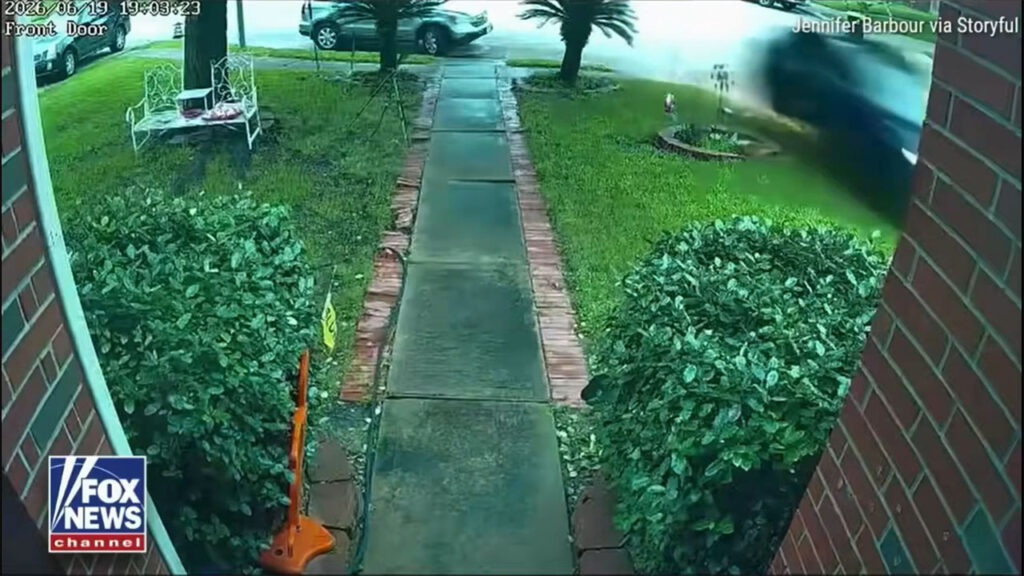
Tesla has officially clarified that a recent Model 3 crash, which resulted in a fatality involving a woman inside a house in Texas, was caused by the driver.
— The Tesla Newswire (@TeslaNewswire) June 22, 2026
According to the data analyzed by VP of AI:
✅ The driver overrode FSD by pressing the accelerator
✅ The accelerator was… https://t.co/KHXRREeA91 pic.twitter.com/spc0eTWIGG
Tesla’s Official Verdict
At first, Tesla CEO Elon Musk expressed his doubts after looking at the footage of the crash that resulted in a fatality. As we can see in recent updates of FSD v14, the AI self-driving system becomes very cautious around vulnerable road users (humans, animals, bicyclists, etc.).
As we can see in the video above, it’s a high-speed crash. In reality, Tesla FSD slows down or completely stops even if it detects a human or animal ahead. This was doubtfully not the act of Tesla FSD.
“Yes, this makes no sense. FSD drives slowly through neighborhood streets and this was a high speed crash!”, Musk wrote on X.
The entire Tesla fleet is connected to the Tesla mothership supercomputer data centers. Fetching the vehicle’s data and its last state isn’t a big issue for Tesla.
Within an hour of Elon Musk’s above statement, Tesla’s Head of AI, Ashok Elluswamy, confirmed that the human driver fully pressed the accelerator pedal and the vehicle had gained a speed of 73 mph (~117 km/h).
Ashok wrote on X:
Yup. In this case, the driver manually overrode self-driving by pressing the accelerator all the way to 100% of the accel pedal in this residential area. They reached a speed of 73 mph during the crash, and had the accelerator pressed even after the crash.
Although the driver was using FSD moments before the crash, he actually took over the system by hardly pressing the accelerator pedal. This might be intentional or unintentional, depending on the driver’s mental state at the time.
If the Tesla driver was unconscious or intoxicated, it might be unintentional. Further investigation into the matter will reveal the actual condition of the driver at the time.
As far as Tesla is concerned, they can always provide authorities with data to back their claims. Stay tuned as this story unfolds further.
Stay tuned for constant Tesla updates. Follow us on:
Google News | Flipboard | X (Twitter) | WhatsApp Channel | RSS (Feedly).
Related Tesla News
- Large number of Tesla Cybercab robotaxis spotted in Houston, hinting at a launch soon
- First responder training and feedback enhance Tesla Cybercab crash and fire safety
- SpaceX to conduct Flight 14 Starship orbital launch on September 22, no landing catch is planned
- Tesla rolls out FSD v14.2 Lite: legacy Tesla owner reviews, rollout status
- Tesla Roadster’s teaser image shows firing SpaceX thrusters, final unveiling date is here, more
- Tesla rolls out FSD v14.3.9 (2026.27.6) with Automatic Collision Evasion: feature details and official release notes


 faces another investigation into Full Self-Driving (FSD) by NHTSA as a result of the fatal crash in Texas. Tesla executives give their side of the story on this accident, more.)