

SpaceX (NASDAQ: SPCX) performed a single-engine static fire test on Starship 40. This is the 40th test prototype of the Starship upper stage spacecraft, also called Ship 40 in short.
Starship 40 is aimed at the upcoming Flight 13 launch and landing test (no final date yet). SpaceX successfully landed Starship 39 in the Flight 12 test last month.
The stock price of Elon Musk’s ambitious space exploration, astronautics, and satellite launch company, SpaceX, fell to its lowest since the historic IPO earlier this month (details below).
Starship 40 Single Engine Static Fire
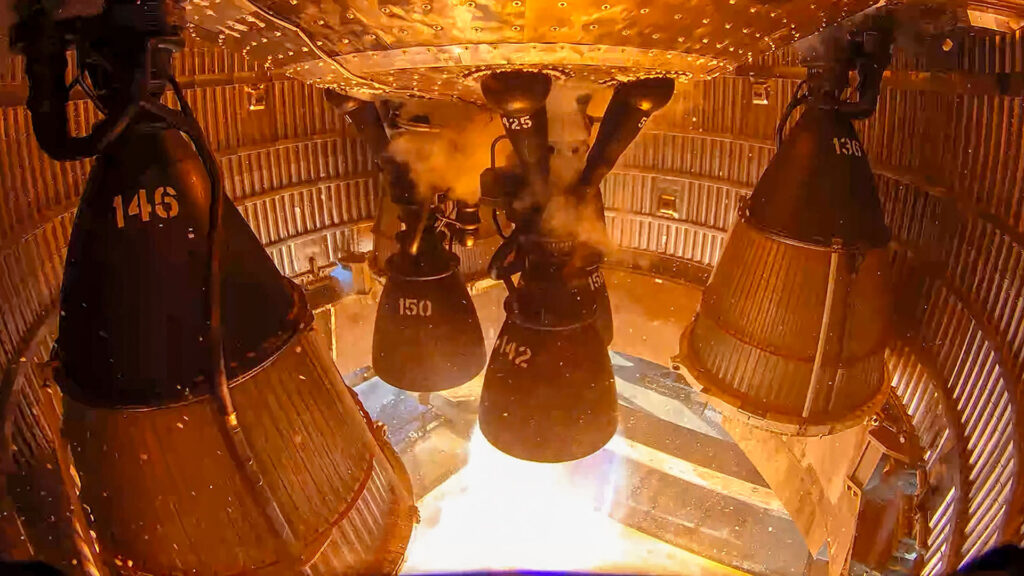
SpaceX shared some stunning views of the static fire test as it took place at the Starbase, Texas, launch site. Especially, the following engine bay view taken during the static fire is particularly stunning.
The following picture shows a single sea-level engine firing, while the other five Raptor 3 engines are silent. SpaceX announced that this was a full-duration static fire test.
The ground observers from the NASASpaceFlight.com team observed that the first Starship Flight 40 single-engine static-fire test lasted just over 10 seconds (video below). A full duration is not a fixed timeline; it’s the time that a rocket team decides before the test takes place.
One theory suggests that SpaceX will limit static-fire tests, as all the Raptor 3 engines are fired and tested at the McGregor, Texas, site before arriving at Starbase for installation.
It’s not completely clear as to why SpaceX performed a single-engine static fire on Ship 40 this time.
Interestingly, SpaceX moved Ship 40 from Megabay 2 at the production site to the Massey’s Outpost testing area on a transport stand (video below). This new crab-like transport stand is also a static fire stand.
SpaceX’s newly designed transport stand relieves the burden of moving Starship to a static fire test stand after transporting the spacecraft to the test site.
The Fall of SPCX
SpaceX (SPCX) went for its IPO (initial public offering) on Friday, June 12, 2026, at the price of $135 a share. On the first day of trading, the price of the SpaceX share jumped to $160.95.
The rally continued for the next two business days. On Monday, June 15, SPCX closed at $192.50. On Tuesday, June 16, the SpaceX stock price reached as high as $225 during the day; however, it started to go down and closed at $201.80 (This was a 50% increase).
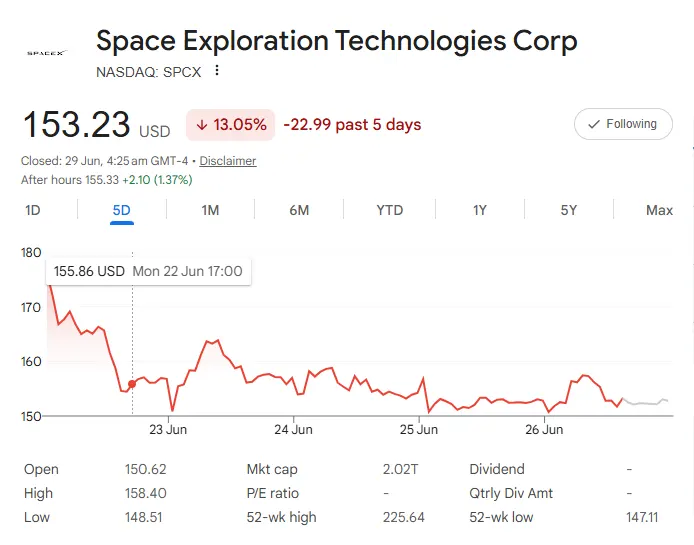
From there, it was a steep downhill for the SpaceX stock. On Friday, 26 June, SpaceX closed at $153.23 on the NASDAQ. This is even lower than the first day of its trading, just ~13% above the IPO price of $135.
In the last 5 business days alone, the SPCX has seen a decline of 13.05% (-$23%). It’s Monday, and a few hours left in market opening. If the price falls further down today, it will be detrimental for Musk’s SpaceX.
Stay tuned for future updates on Starship and SpaceX. Follow us on:
Google News | X (Twitter) | Flipboard | WhatsApp Channel | RSS (Feedly).
Related SpaceX News
- SpaceX to conduct Flight 14 Starship orbital launch on September 22, no landing catch is planned
- Tesla Roadster’s teaser image shows firing SpaceX thrusters, final unveiling date is here, more

- Landing catch of Starship in Flight 14 gets environmental clearance from the FAA

- FCC filing reveals Starship Flight 14 launch on September 15, SpaceX conducts 33-engine static fire on Booster 21

- Starship 40 begins its journey from the Indian Ocean back home to Starbase, Texas

- After Starship’s 60-second 6-engine static fire, SpaceX rolls out Flight 14 Booster 21 for pre-launch testing


. SPCX stock price falls to the lowest since IPO, more.)