Yesterday, SpaceX successfully launched a Starship developmental spacecraft for the 12th time. It was the first prototype of the Starship V3 generation.
V3 Starship consists of the newer generation of all the major components, i.e.:
- Starship V3 upper-stage spacecraft
- Super Heavy V3 rocket booster
- Raptor 3 Starship engines
SpaceX attempted the Flight 12 Starship test (IFT-12) on Thursday. However, due to a technical glitch in the launch tower’s QD arm, the first attempt was called a scrub (cancelled).
The second attempt at launching and landing the Starship successfully met its major milestones. SpaceX shared some spectacular views as the world’s largest rocket took off from the launch pad, and when its upper stage landed in the Indian Ocean (near Australia).
Flight 12 Starship Liftoff
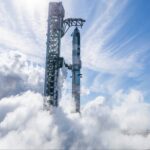
The following picture, posted by SpaceX on X, shows the epic moment when the Flight 12 Starship lifted off from Pad 2 orbital launch mount (OLM) on Friday, May 22.
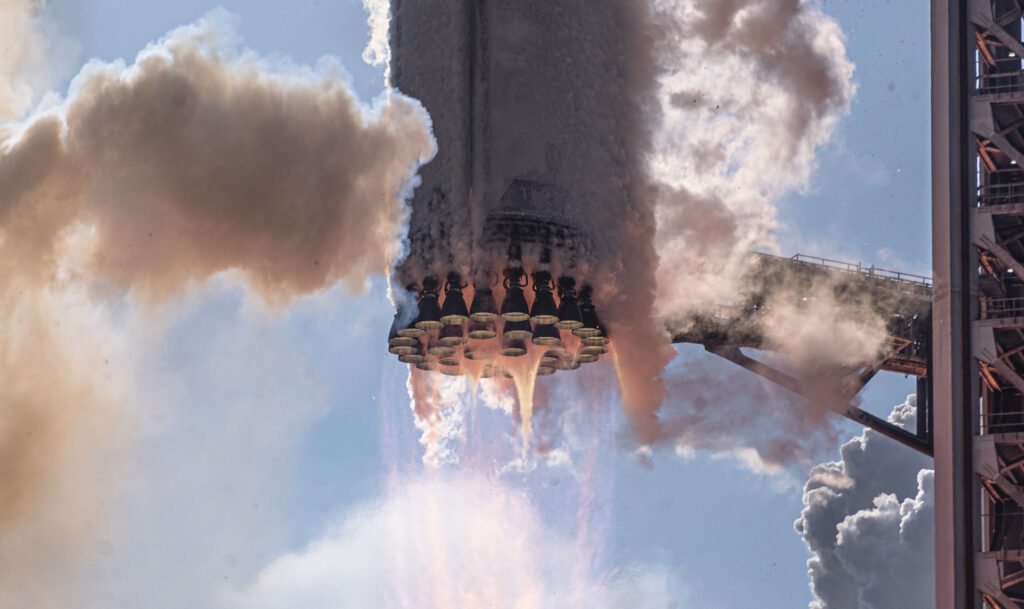
33 latest-generation Raptor engines ignited simultaneously, creating a massive downward thrust. This resulted in a successful liftoff from Pad 2 OLM at Starbase, Texas.
Just a day before, SpaceX had to call off the mission because of a malfunction in the quick-disconnect (QD) arm. However, in Friday’s 2nd attempt, the QD arm mechanism detached seamlessly, and the Flight 12 Starship lifted off the launch mount as intended by the SpaceX team.
An interesting fact revealed during the live webcast of the Flight 12 launch is that the new Pad 2 deluge system starts firing water under the Super Heavy rocket 17 seconds before the engines start ignition.
In the debut Flight 1 Starship test in 2023, the thrust of the Raptor engines created a massive hole in the launch mount. This triggered a continuous effort by SpaceX engineers and technicians to improve the heat and thrust mitigation system at liftoff.
The new deluge system and flame trench integrated in Pad 2 worked perfectly during the 12th Starship launch test.
Liftoff of Starship! pic.twitter.com/LQLdjK5V6K
— SpaceX (@SpaceX) May 22, 2026
Flight 12 Starship Landing
When we have talked about the beginning, why not also bring the end to the discussion table? The final landing of the Starship was no less epic than the liftoff we’ve observed above.
After a successful stage separation event (detaching from Booster 19), Starship 39 coasted in suborbital space for a while. Around T+1 hour, 6 minutes, and 20 seconds, the Flight 12 upper stage Ship 39 touched the surface of the ocean.
Although the aft section of the Starship landed on water, Ship 39 didn’t land vertically at a 90° angle this time. The landing burn also did not work properly as it did in the previous Flight 11 test (the ship landed perfectly on water).
SpaceX was also not able to perform an in-space engine relight test. This resulted in excess propellant present in the header tanks upon landing. This is why there was a massive explosion observed seconds after the ship fell into the water (video below).
For a detailed events log of the Starship Flight 12 test (IFT-12), you can read our live updates archive of the launch.
Congratulations @SpaceX! This coverage is so incredible, each one of these streams helps inspire people to get into engineering pic.twitter.com/ErhcmPnzbA
— Joe Barnard 🚀 (@joebarnard) May 22, 2026
Stay tuned for future updates on Starship and SpaceX. Follow us on:
Google News | X (Twitter) | Flipboard | WhatsApp Channel | RSS (Feedly).
Related SpaceX Starship News and Updates
- SpaceX deployed 26 terabits per second of Starlink V3 bandwidth in a single Starship launch (Flight 14)
- Watch Flight 14 Starship launch live stream recordings and read the live updates archive
- SpaceX completes Starship Flight 14 launch rehearsal, gets final FAA approval for launch on Monday, more
- SpaceX (SPCX) President Gwynne Shotwell files to sell $52M worth of the company’s shares

- Starship Flight 14 gets delayed, SpaceX moves Booster 21 to Starbase launch pad, more
- Starship Flight 14 orbital launch: planned trajectory, mission objectives, no landing catch