SpaceX (NASDAQ: SPCX) released its Q3 2026 financial results and held the earnings call yesterday (Tuesday, October 20, 2026).
Interestingly, SpaceX switched from a traditional audio webcast to a live earnings video call. Most likely, at least for SpaceX, this will become the standard format going forward.
In his opening remarks, Elon Musk announced that SpaceX will attempt to catch both the Super Heavy booster and the Starship upper stage in the upcoming Flight 15 launch test (IFT-15).
Musk’s commercial spaceflight, satellite, and super AI company released its Q3 2026 financial results (PDF below).
The summary of the current financial situation of the company is described in the official document as:
SpaceX Reports Third Quarter 2026 Results
Delivered revenue of $14.6 billion, up 161% year-over-year, fueled by our Super Intelligence (SI) segment and
accelerated growth in Connectivity
Achieved income from operations of $2.8 billion, net income of $4.4 billion, and Adjusted EBITDA of $8.8 billion
Successfully launched our first revenue-generating Starship mission, delivering 26 Starlink V3 satellites to our
broadband constellation, representing approximately 10x the downlink capacity added by a Falcon 9 Starlink
launch
Continued to scale nameplate compute, reaching 1.7 GW as of September 30, 2026
Added $6.7 billion of incremental SI solutions and infrastructure revenue year-over-year, driven by cloud
services agreements, the acquisition of Cursor, and our growing SI models and software applications, including
Grok Bot
Delivered year-over-year revenue growth of 69% and income from operations growth of 99% for the
Connectivity segment, supported by strong momentum in enterprise and government adoption, and continued
Starlink consumer subscriber growth
– Advertisement –
SpaceX (Nasdaq: SPCX) announced the following financial results for the quarter ended September 30, 2026, as compared to the prior year quarter:
Revenues of $14.6 billion, up 161% from $5.6 billion
Net income of $4.4 billion, an improvement of $5.5 billion from net loss of $1.1 billion
Adjusted EBITDA of $8.8 billion, up 306% from $2.2 billion
CFO Commentary:
We delivered another strong quarter in Q3. Revenue grew an impressive 161% year-over-year, fueled by continued momentum in Connectivity and a clear inflection in our Super Intelligence business. The combination of our launch leadership, recurring Starlink revenue, and the significant expansion of our SI infrastructure continues to drive meaningful operating leverage.
We are building the infrastructure of the future with discipline — focused on capital efficiency, strong returns on invested capital, and maintaining a robust, investment-grade balance sheet — while moving with the velocity to capture the opportunity in front of us.
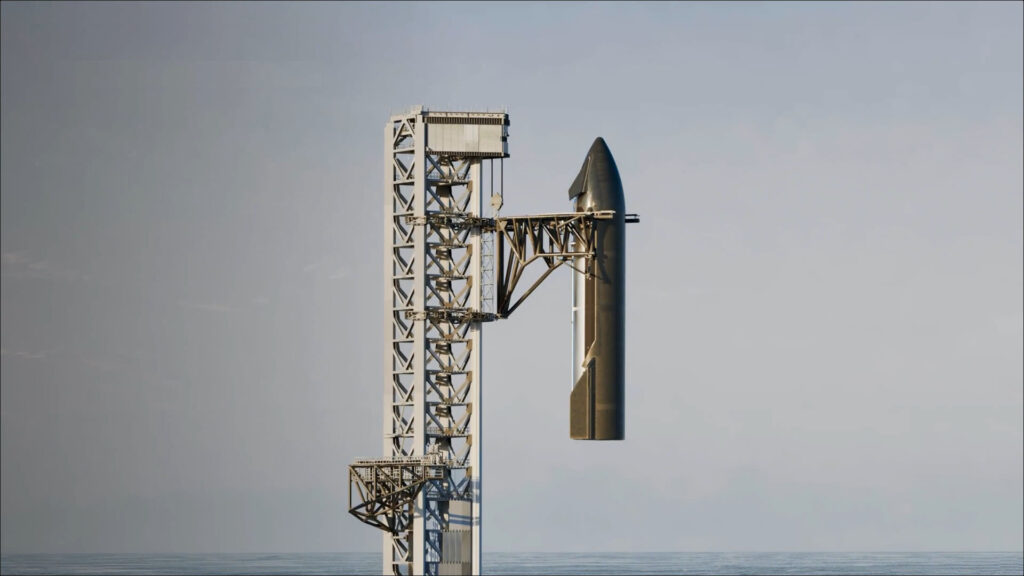
Catching the upper stage Starship spacecraft with the Starbase launch tower Chopstick arms was planned for Flight 14. However, in favor of the orbital launch, SpaceX dropped this from the Flight 14 milestones.
Musk’s SpaceX Q3 2026 announcement has made the upcoming Flight 15 launch-and-landing test (IFT-15) even more interesting, as the launch tower will catch both vehicles (Super Heavy Booster 22 and Starship 42)
SpaceX CEO Elon Musk showed an animated simulation of an upper-stage Starship on the Q3 2026 live earnings video call (watch recording below). However, the simulation did not show the Super Heavy booster catch.
It leaves open the question of whether SpaceX will re-stack Starship on top of the Super Heavy booster after the catch. Because the first/lower stage booster returns to the launch site or designated splashdown location, and the upper stage lands later.
– Advertisement –Simulated view of the Starship upper stage catch by the launch tower at Starbase (planned for Flight 15, video below). Credit: SpaceX.
Brief History of Starship Booster Catches at Starbase, Texas
Because Starship is designed for rapid reusability, the original plan was to catch both stages with the launch tower arms (aka the Chopsticks). Landing legs hinder reusability in multiple ways.
After Flight 5, Musk said that SpaceX would catch the Starship upper stage in the Flight 6 test. However, SpaceX never attempted the ship catch.
Because of a smooth splashdown landing in the Indian Ocean, Flight 13 has since become a pre-qualification test for attempting a catch in the next flight.
SpaceX had to abort the catch of the Super Heavy booster in Flight 6 because of technical reasons. However, SpaceX successfully caught the booster in Flight 7 and Flight 8 tests.
Here’s a list of successful Starship booster catches at Starbase, Texas:
This would require 10 flights with SpaceX’s smaller Falcon 9 rockets to add the same amount of bandwidth to Starlink. Interestingly, Starship wasn’t even at full payload capacity on Flight 14.
On the Q3 call, Elon Musk said SpaceX will increase Starlink satellite bandwidth capacity 100 times the current level over the next 3 years. SpaceX aims to deploy around 100,000 Starlink V3 satellites in this timeframe.
According to Musk, due to immense communications requirements by AI agents, the need for bandwidth will increase to 1000 times that of today’s. This phenomenon will increase demand for Starlink’s high-speed, low-latency satellite broadband.
At the end of the third quarter of 2026, SpaceX has 13.6 million Starlink subscribers with an ARPU (average revenue per user) of $69.
Starlink service is available in 174 countries, with 11.1K satellites in orbit (majority Starlink V2s and 26 V3s).
SpaceX is also building direct-to-cell connectivity wherever Starlink is allowed to operate.
SpaceX (SPCX) Q3 2026 Earnings Call and Financial Update is scheduled for 3:30 PM Central Time and 4:30 PM Eastern Time!https://t.co/fNjtNENDWe
SpaceX Super Intelligence and $500B to $1T Revenue
Across Tesla and SpaceX, Elon Musk is using the term Super Intelligence (SI) instead of Artificial Intelligence (AI). As the term suggests, it is superior to AI.
Grok is SpaceX’s AI bot. According to Musk, as it improves with time and version iterations, SpaceX expects growth in paid users of the AI chatbot platform.
SpaceXSI is also aiming to increase its enterprise customer base by improving its Grok AI bot.
Musk said the following about the Grok bot and the Super Intelligence (SI) horizon at SpaceX:
We’ll be deploying Grok bot at scale for enterprise customers, which is a very big deal. So that it could be effectively used in teams by companies, as though it were a virtual human.
We’re already in early deployment with some customers, and we expect to be in wide deployment within a few weeks, for enterprise customers for Grok bot.
I think Grok bot may end up being what uses most of our Super Intelligence compute.
I mean, in a nutshell, what this implies for SpaceX annual recurring revenue by the end of 2027 is somewhere between $500 billion and a trillion [1 trillion dollars].
SpaceX (SPCX) Q3 2026 Financial Results
Stay tuned for future updates on Starship and SpaceX. Follow us on:
Author of more than 1500 articles on Tesla, SpaceX, and EVs. His work has been liked and tweeted by Elon Musk and other prominent influencers. You can reach him on Twitter @IqtidarAlii
On Thursday, October 15, the world was astonished when Tesla demonstrated its next-generation Tesla Roadster's flying capabilities.
Beyond its over-the-top...



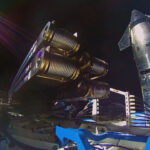
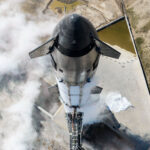


 team reveal the financial and operational details of Q3 2026 and future outlook with Starship, Starlink, and Super Intelligence (Grok, SpaceXAI) revenue of $500B to $1T (earnings call video, more).)