

In a new development, SpaceX has changed the target date for the Starship Flight 6 launch and landing-catch test.
Previously, SpaceX targeted Monday 18th November for the Flight 6 test (IFT-6). For various reasons, the spaceflight company has now rescheduled Flight 6 launch target date to Tuesday 19th November.
SpaceX will now attempt to perform the Starship Flight 6 orbital flight and landing-catch test on Tuesday 19th November. Elon Musk’s SpaceX announced the new date via his social media platform X and on the company’s official website.
“The sixth flight test of Starship is targeted to launch Tuesday, November 19. The 30-minute launch window will open at 4:00 p.m. CT,” SpaceX wrote in the press release.
Related: Watch the live-stream recordings of Starship Flight 6 launch and landing test | The reason for Flight 6 Super Heavy catch abort
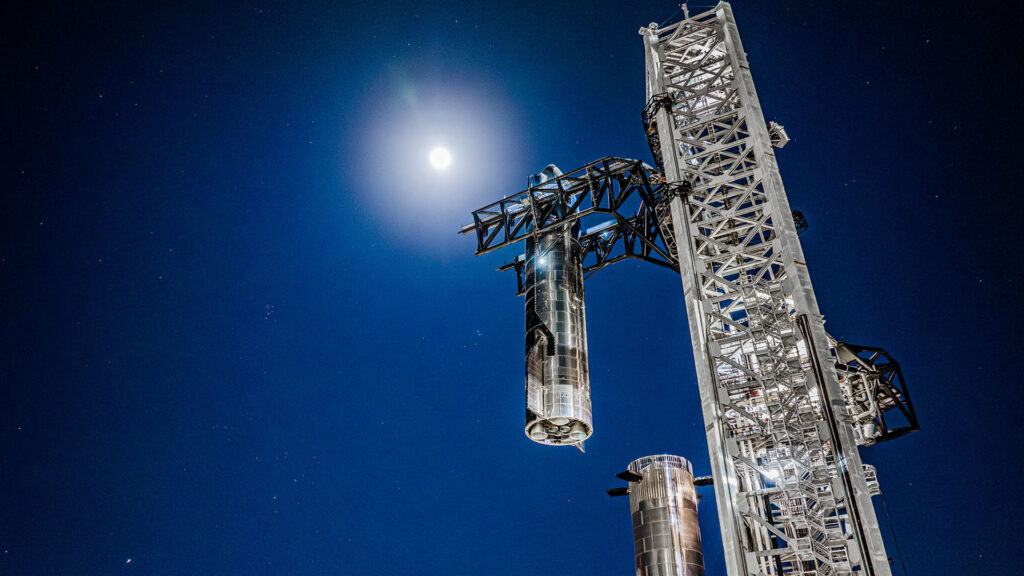
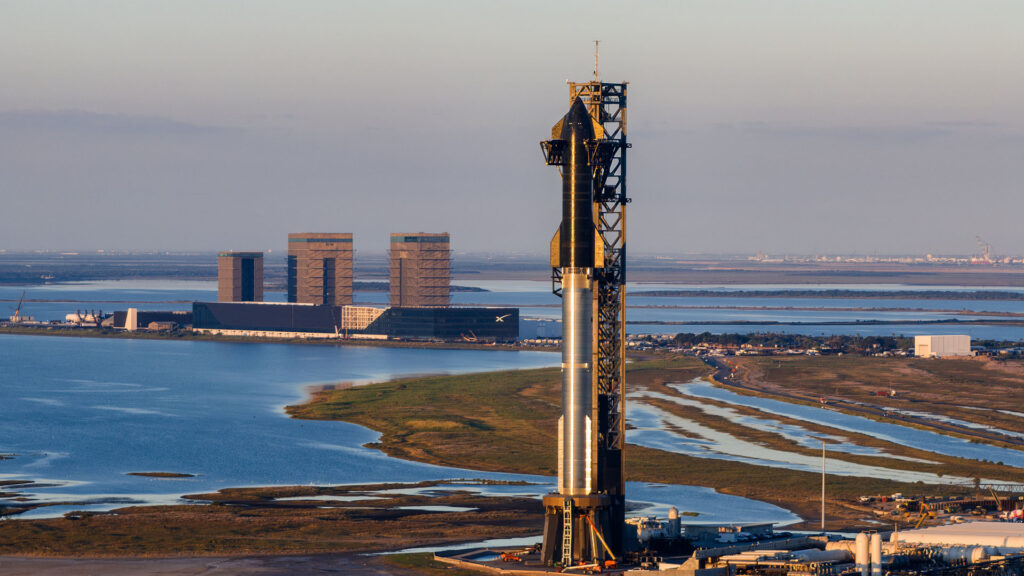
With the announcement of the new Starship IFT-6 date, SpaceX also posted some amazing photos of the Flight 6 Starship.
These latest photos show both major components of the Flight 6 Starship getting integrated for the orbital flight and landing test on Tuesday. The lower 1st-stage Super Heavy Booster 13 (B13) is mounted on the OLM and the launch tower Chopsticks lifted the upper 2nd-stage Ship 31 to mount it on the booster.
When the upper stage spacecraft is mounted on the booster, a Starship is called ‘fully integrated’. And when the fully integrated Starship is launched, it’s called an IFT (integrated flight test). Therefore, the upcoming Starship test is named IFT-6 (the sixt integrated flight test of \ Starship prototypes Ship 31 and Booster 13).
We chalked-out the Starship IFT-6 trajectory for both the 1st and 2nd stage vehicles in one of our previous Flight 6 reports.
SpaceX added the following more interesting information in the latest Flight 6 press release to explain the goals, actions, and types of data they want to gather from the upcoming test on Tuesday next week.
Several thermal protection experiments and operational changes will test the limits of Starship’s capabilities and generate flight data to inform plans for ship catch and reuse.
The flight test will assess new secondary thermal protection materials and will have entire sections of heat shield tiles removed on either side of the ship in locations being studied for catch-enabling hardware on future vehicles.
The ship also will intentionally fly at a higher angle of attack in the final phase of descent, purposefully stressing the limits of flap control to gain data on future landing profiles.
Finally, adjusting the flight’s launch window to the late afternoon at Starbase will enable the ship to reenter over the Indian Ocean in daylight, providing better conditions for visual observations.
Stay tuned for constant Tesla updates. Follow us on:
Google News | Flipboard | X (Twitter) | WhatsApp Channel | RSS (Feedly).
Related SpaceX / Starship News
- Starship 40 begins its journey from the Indian Ocean back home to Starbase, Texas

- After Starship’s 60-second 6-engine static fire, SpaceX rolls out Flight 14 Booster 21 for pre-launch testing

- Flight 13 Starship (S40) completes one month in the Indian Ocean, watch the latest recovery efforts by SpaceX

- Starship Flight 14: SpaceX performs a single-engine static fire test on Ship 41, Starbase updates (videos)
- Tesla to reportedly unveil the next-gen Roadster in August, with SpaceX thrusters of-course

- Space, Connectivity, AI: Key takeaways from Elon Musk’s SpaceX Q2 2026 Earnings Call



 date. Shares new photos of the fully stacked Flight 6 Starship from Starbase, Boca Chica, Texas. Info on the launch goals.)