SpaceX (NASDAQ: SPCX) has announced its planned date for the next Starship launch. Elon Musk’s space company will attempt the Flight 14 Starship launch (IFT-14) on Tuesday, September 22, 2026.
The 14th flight of Starship is preparing to launch as soon as Tuesday, September 22, pending regulatory approval. The 75-minute launch window will open at 7:15 a.m. CT.
Over the past two weeks, SpaceX has been working to secure approvals from the Federal Aviation Administration (FAA) and the Federal Communications Commission (FCC) to conduct Starship’s 14th flight.
Before the September 22 confirmation date, an FCC filing hinted that Flight 14 was planned for September 15. Most likely, the Starship launch was delayed by a week due to regulatory delays.
Contrary to Elon Musk’s claims that SpaceX will attempt to catch the Starship upper stage in Flight 14, it has been completely removed from the planned mission objectives.
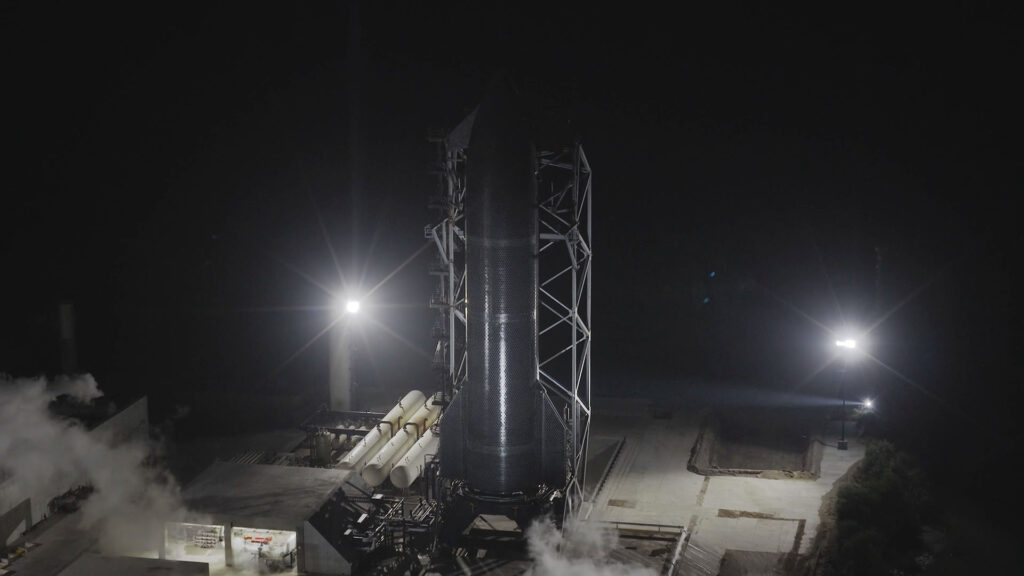
– Advertisement –Flight 14 Starship 41 mounted on a test stand at the Massey’s Outpost, Starbase, Boca Chica, Texas. Credit: SpaceX.
No Landing Catch in Flight 14
SpaceX was eager to attempt a landing catch of the Starship upper-stage spacecraft in Flight 14. The company was even granted an environmental clearance to descend Starship to Starbase for a landing catch.
However, as the FAA clarified in a message to us, the environmental clearance does not mean approval for an aerospace operation. Most probably, SpaceX still hasn’t been granted approval for a landing catch of the upper stage at Starbase, Texas.
Flight 14 Planned Trajectory
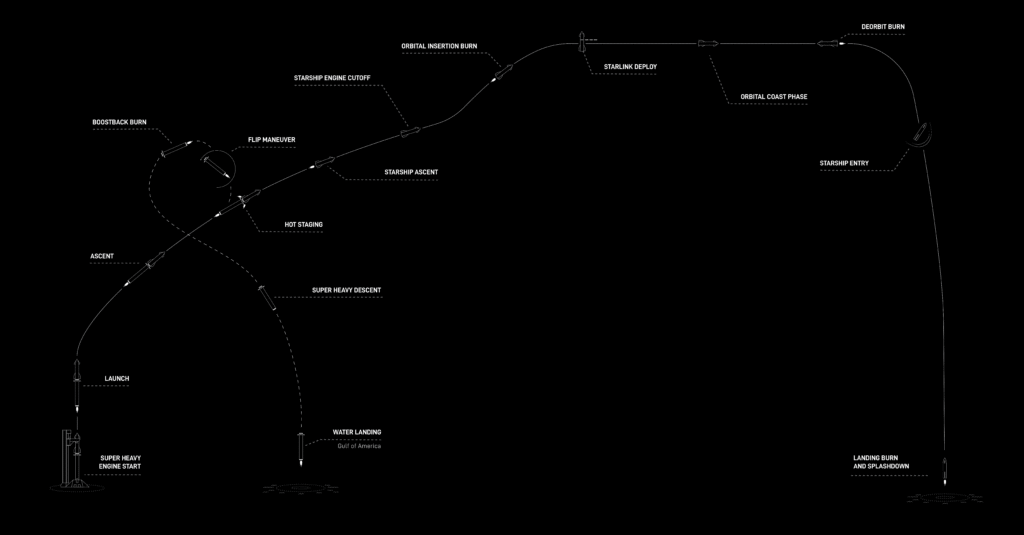
Since the landing catch of the upper stage has been canceled in Flight 14, the Starship spacecraft will now target a soft splashdown landing in the Pacific Ocean to the west of Chile.
This time, SpaceX has also changed the upper-stage splashdown landing target from the Indian Ocean to the Pacific Ocean. This is because Flight 14 Starship will coast in orbit instead of being suborbital.
In Flight 14, the orbital Starship will reach a maximum altitude of 275 km (170 miles) above sea level.
All previous Starship launches have been suborbital on purpose. Starship’s 14th launch will be the first mission in which the upper stage will reach orbit. Ship 41 will make six rounds in orbit, which will take around 10 hours to complete.
The upcoming flight is planned to be the first to send Starship into orbit around Earth. Flight tests until this point have intentionally flown passively safe suborbital trajectories to maximize public safety while allowing for maximum learning. By going to orbit, the next phase of developing Starship to be fully and rapidly reusable can begin.
Starship’s initial orbital mission is expected to fly at an altitude approximately 275 km above Earth and complete approximately six orbits around the planet over the course of a nearly 10-hour flight, with splashdown targeted in the Pacific Ocean to the west of Chile.
– Advertisement –
For the first 13 Starship flight tests, we’ve intentionally placed the upper stage on a passively safe suborbital trajectory. This effectively meant that when Starship’s engines turned off at the end of its ascent burn, it did not have the forward velocity necessary to achieve orbit. These trajectories are considered “passively safe” because even if control over the spacecraft was completely lost, it was already on a path to reenter the atmosphere and splash down in a pre-determined location. This mission design allowed us to gather flight data about hardware in a real flight environment while maximizing public safety. For Starship’s initial orbital flights, it will still be placed initially on a passively safe suborbital trajectory and require a second burn to achieve orbit.
Diagram of Flight 14 Starship launch and landing trajectory (click/tap to open high-resolution version). Credit: SpaceX.
Starship Flight 14 Objectives
In short, SpaceX has two major objectives for the Flight 14 Starship mission:
The orbital launch of the Starship upper stage
Deployment of 26 Starlink V3 real working satellites
SpaceX explained these further as:
The booster’s primary test objective on Flight 14 will be executing a successful launch, ascent, stage separation, boostback burn, and landing burn at an offshore landing point in the Gulf of America. There have been several modifications to hardware and software to address issues seen on the previous flight.
The Starship upper stage’s primary objectives include the first orbital insertion maneuver, the deployment of 26 Starlink V3 satellites, a deorbit burn using a single Raptor engine while in space, and a controlled reentry, descent, and splashdown in the Pacific Ocean. Starship will only execute a burn to enter orbit after the flight control team has ensured there is sufficient redundancy on hardware critical to doing the subsequent deorbit burn at the end of the mission.
– Advertisement –
Starship will deliver 26 Starlink V3 satellites to orbit for the first time, which aim to greatly expand the network’s capacity and user speeds. Each Starlink V3 satellite will add 1 Tbps of capacity to the constellation, for a total of 26 Tbps of capacity added on this mission alone. That’s ~10x the capacity compared to a single launch of V2 mini Starlink satellites on Falcon 9.
After deploying from Starship, the Starlink V3 satellites will unfold their antennas and deploy their solar arrays and make initial contact with the ground and the rest of the Starlink constellation via radio frequency and laser links. The satellites will then begin raising their orbits with their onboard thrusters. Following their on-orbit checkouts, the satellites should begin serving customers as soon as a few weeks after launch.
Three of the satellites have been modified with a suite of cameras to scan Starship’s heatshield and transmit imagery down to operators to continue testing methods of analyzing Starship’s heatshield readiness for return to launch site on future missions.
Author of more than 1500 articles on Tesla, SpaceX, and EVs. His work has been liked and tweeted by Elon Musk and other prominent influencers. You can reach him on Twitter @IqtidarAlii
SpaceX (NASDAQ: SPCX) filed for a Starlink operation and satellite-to-Earth communications permission with the Federal Communications Commission (FCC) on...









 announces the date for Starship's 14th launch test (IFT-14). No landing catch this time. Get the details on the mission trajectory and objectives.)