Through the years, Jay Leno’s Garage has featured multiple Tesla cars, the Cybertruck, and Tesla’s early prototype of the Semi. Now, in the new episode of the show, Jay Leno did not just test-drive the Semi-truck; he also asked tough technical questions to Tesla executives.
The conversation between Jay Leno, Tesla’s Chief Designer, Franz von Holzhausen, and Tesla Semi Program lead engineer Dan Priestly revealed a lot of new details of the design and engineering of the vehicle.
The Tesla Semi-truck aims at transitioning the logistics industry to electrification, which currently relies on diesel trucks for the most part. Using heavy-duty electric trucks for goods transportation will not only lessen emissions, but Tesla claims that it will reduce shipping costs as well (read the details below or jump directly to the video).
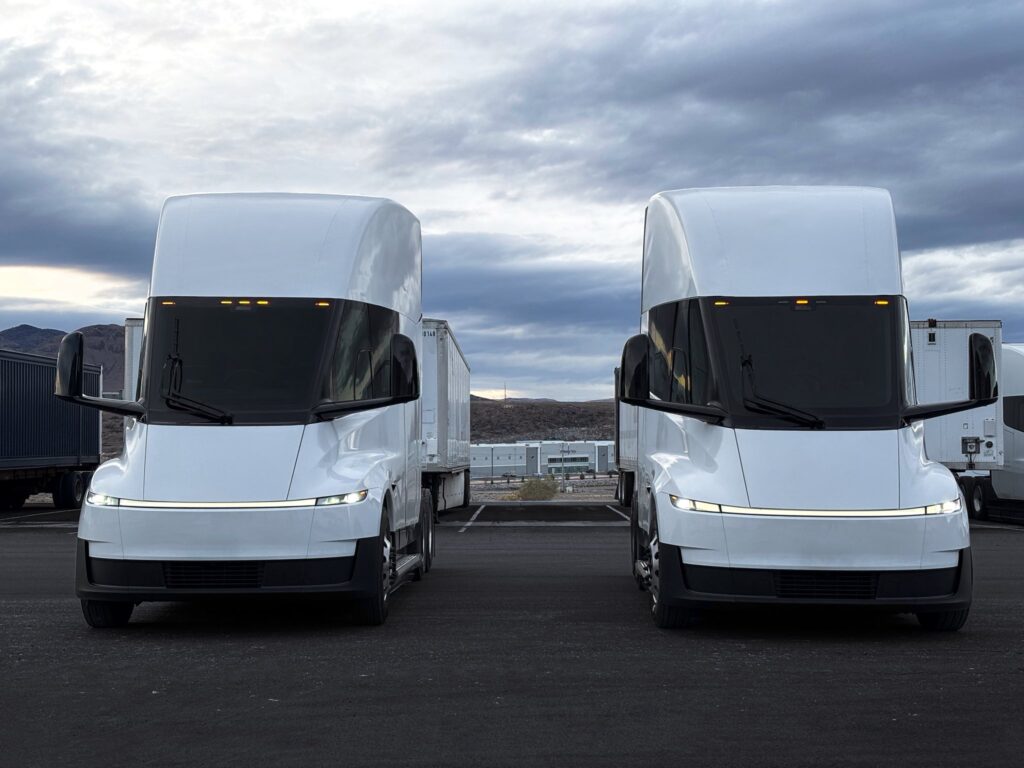
– Advertisement –Two design-refreshed Tesla Semi trucks parked in the open at Giga Nevada. Credit: Courtesy of Tesla, Inc. (TSLA).
Tesla Semi’s cabin is unique for a class-8 semi-truck. The driver’s seat is in the middle with two screens on both sides. Tesla calls it the ‘Cabin Office’ for the truck operator, as it’s built around the driver. There’s also an additional seat behind the driver on the right side for the helper/jumper.
The design of the Tesla Semi cabin also allows for maximum visibility for the driver. In addition to cameras on the side, Tesla Semi also offers two giant side mirrors to increase rear visibility for safety.
Aerodynamics
The front-end of the Tesla Semi is designed for maximum aerodynamic efficiency. Tesla Chief Designer Franz von Holzhausen confirmed that the truck’s coefficient of drag is 0.4 Cd.
Generally, semi trucks have a Cd of 0.5 to 0.9. Tesla Semi’s drag coefficient of 0.4 is considered excellent compared to that of traditional diesel trucks.
The optimal aerodynamic design of the Tesla Semi allows it to consume less energy as it cruises through different terrains, especially deserts and coastal highways, where the wind pressure is usually more than in the city environment.
– Advertisement –Tesla Semi-truck is redesigned to follow the Model Y and Cybercab design language. Credit: Courtesy of Tesla, Inc. (TSLA).
Tesla Semi Engineering Innovations
Tesla’s Dan Priestly didn’t shy away from any hard questions thrown at him by Jay Leno. Dan answered the engineering and technology-related questions in detail.
This valuable conversation gave us several new insights into the development of the Tesla Semi-truck. It took several years for Tesla from building early prototypes to building the dedicated factory in Giga Nevada, and starting production this year.
According to Dan, Tesla Semi has received several engineering changes. Some of these changes have transitioned from other Tesla vehicles, as the systems improved through constant innovation.
Electric Steering System
Dan Pirestly revealed that the Tesla Semi steering system has been re-engineered. During the early prototype stage, Tesla used a hydraulic-assisted steering system in the Semi-truck.
Tesla Semi now uses a full electrically-assisted steering system. This improvement is imported from the Cybertruck, which uses a steer-by-wire system.
However, the Tesla Semi does not have a steer-by-wire system. The Semi’s electric steering system uses beefed-up actuators from the Cybertruck.
Electrically-assisted steering makes the Semi feel like you’re driving a regular Tesla, especially if there’s no trailer attached. Jay Leno experienced the ease of driving the Tesla Semi during his test drive review (watch below).
– Advertisement –
Battery: 48-Volt System
One more improvement brought from the Cybertruck to the Tesla Semi is the 48-volt battery. Tesla’s Dan Priestly confirmed that the production-intent Semi-truck now incorporates a 48-volt architecture.
The 48-volt battery output in the Cybertruck proved to be more efficient than the 12-volt lithium-ion batteries in Model Y, Model 3, and so on. Using a DC-to-DC converter, the Tesla Semi-truck has 12-volt outlets in the cabin in-case the driver needs it for accessories.
The Cybertruck teardown revealed that Tesla still used 12-volt components and modules in the truck because of supply chain issues (video below). However, a DC-to-DC converter circuit steps down 48 to 12 volts, so that these components can run efficiently.
According to Dan, using the 48-volt system, Tesla was able to reduce the number of wiring harnesses, and it also helped lower the mass of the entire electrical system in the Tesla Semi and the Cybertruck.
Video: Sandy Munro’s team tore down a Cybertruck 48V system.– Advertisement –
Structural Battery Packs, 4680 Cells
The Tesla Semi battery pack is highly integrated into the truck’s chassis. The Semi-truck uses the same 4680 form-factor cells in its structural battery. Compared to the Cybertruck, 4680 cells in the Semi are arranged in a different array, as Dan described in the video.
From what Dan said, the Tesla Semi-truck does not have a single battery pack. It has multiple battery packs installed to support the electrical architecture and power the heavy-duty trailer towing.
The battery modules are integrated low to the ground to keep the center of gravity low. A low center of gravity provides better handling of a vehicle and significantly reduces the risk of a rollover.
“It’s integrated really densely with the overall chassis to maximize structural performance,” Dan Priestly said.
Battery Longevity, Charge, Discharge Frequency
The interesting question for truckers and logistics companies is how long the battery of the Tesla Semi would survive. The answer is it’s designed and engineered to last for the lifetime of the vehicle.
“The battery is designed to last a million miles,” Dan said. Although the battery would degrade over time, it would retain most of its capacity in the long run.
Tesla Semi’s battery is made to withstand frequent charging and discharging. This is important for both long-haul logistics and transportation, as the battery would be drained multiple times a day.
“It’s designed like the Megapack or Powerwall on wheels,” Dan said. Tesla Semi has a large battery pack, and Tesla gave it a usage frequency like a commercial large-scale battery storage system, as Dan described.
The more energy throughput you are putting through the system, the greater fuel savings you have if you were doing that work with diesel.
– Advertisement –
So, it’s really about getting it on the road as much as you can.
The large battery pack of the Tesla Semi needs a powerful and efficient thermal management system. Both extreme heat and cold temperatures affect the battery’s efficiency, performance, and safety.
According to Tesla, the sealed liquid coolant running in the cooling channels of the battery pack has the same life as the battery. In the case of the Tesla Semi, it’s around 1 million miles. Tesla Semi owners will virtually never need to replace the coolant.
High energy and frequent energy throughput create heat in the battery pack. Tesla’s integrated cooling system keeps the battery pack at optimal temperature.
Extreme cold weather generally results in fast battery drain. However, Tesla overcame this problem by integrating a heat pump. Tesla Semi also has a heat pump to keep its battery warm in harsh cold climates.
Tesla Semi doesn’t just rely on the heat pump, though. The battery pack of the Tesla Semi is a cubical shape, rather than a pancake. This also helps it conserve heat overnight, keeping itself warm enough to be ready for operation the next morning.
According to Dan, the Tesla Semi’s heat pump and attached architecture can also transfer heat from the motors, brakes, any other component, and even from the outside to the battery pack. This entire architecture keeps the battery pack warmed up at operating temperature if additional heat is required.
– Advertisement –
This is a unique system that helps the Tesla Semi perform better in extreme cold-weather conditions. A Tesla Semi was recently spotted cold-weather testing in Alaska. So, Tesla is considering the real-world weather conditions to achieve optimal range in various terrains and temperatures.
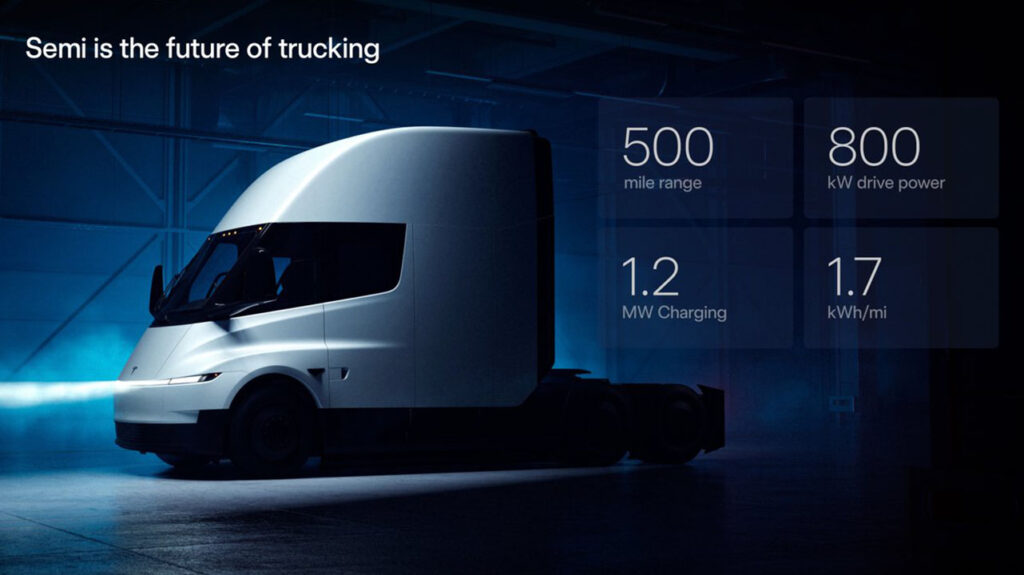
Tesla offers two variants of the Tesla Semi. The smaller one comes with a range of 325 miles (~520 km), and the long-hauler has a 500-mile (~800 km) range. Tesla Semi’s range drop in cold weather conditions is not as bad as usually thought, Dan said.
The bobtail Tesla Semi-truck (without trailer), performing cold-weather testing in Alaska. Credit: Courtesy of Tesla, Inc. (TSLA).
Energy Efficient Single-Speed, Two-Axle Powertrain
Tesla’s Semi-truck engineering team didn’t just focus on the electrical and electronics of the vehicle to save energy; it also considered the mechanical components.
The Tesla Semi’s powertrain is unique. Program Lead, Dan Priestly, described that the Tesla Semi has two axles that have their own unique functions.
The front axle of the Tesla Semi does most of the heavy lifting, so Tesla engineers call it the ‘torque axle’. It is used for acceleration, hill-climb, and power maneuvers. After reaching highway speeds, the front torque axle is completely disengaged, and nothing is spinning internally, which saves energy.
At highway speeds and flatter roads, only the rear axle is engaged to provide the needed power. This single-speed system is designed to eliminate the need for a two-speed transmission in the Tesla Semi. Again, this single-speed powertrain was originally built for the Tesla Model S Plaid.
Jay Leno’s Garage: Tesla Semi, Dan Priestly, and Franz von Holzhausen
Author of more than 1500 articles on Tesla, SpaceX, and EVs. His work has been liked and tweeted by Elon Musk and other prominent influencers. You can reach him on Twitter @IqtidarAlii










.)