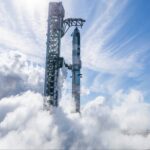
Earlier this morning, Elon Musk, the CEO of SpaceX, confirmed on his social media platform X that the Flight 13 Starship launch is still on track for its original schedule of Thursday, July 16 (5:45 PM CT / 6:45 PM ET).
Musk denied any rumors of delays or cancellation of the 13th Starship launch and landing test (IFT-13). Predicting a flight delay at this time is pointless, as SpaceX will evaluate tomorrow’s weather and technical conditions to announce a go or hold.
SpaceX always has backup launch windows if anything goes unplanned. These launch windows are usually in the following two days of the original launch date.
Starship launch cadence has significantly improved recently, as the Flight 12 Starship test was performed less than 2 months ago.
Flight 12 experienced an anomaly at stage separation that resulted in a directional flip of the Super Heavy booster and an unplanned engine ignition on descent. This anomaly triggered an FAA mishap investigation, but SpaceX obtained approval for Flight 13, and it’s about to happen as soon as tomorrow.
According to the Flight 13 update on its official website, SpaceX aims to perform a similar launch and landing test as Flight 12. However, this time, SpaceX has tried to mitigate the causes of the Flight 12 anomaly.
Flight 13 is the 2nd launch of the V3 Starship prototype (both the first-stage Super Heavy rocket booster and the 2nd/upper stage Starship spacecraft used in this launch are the new V3 generation).
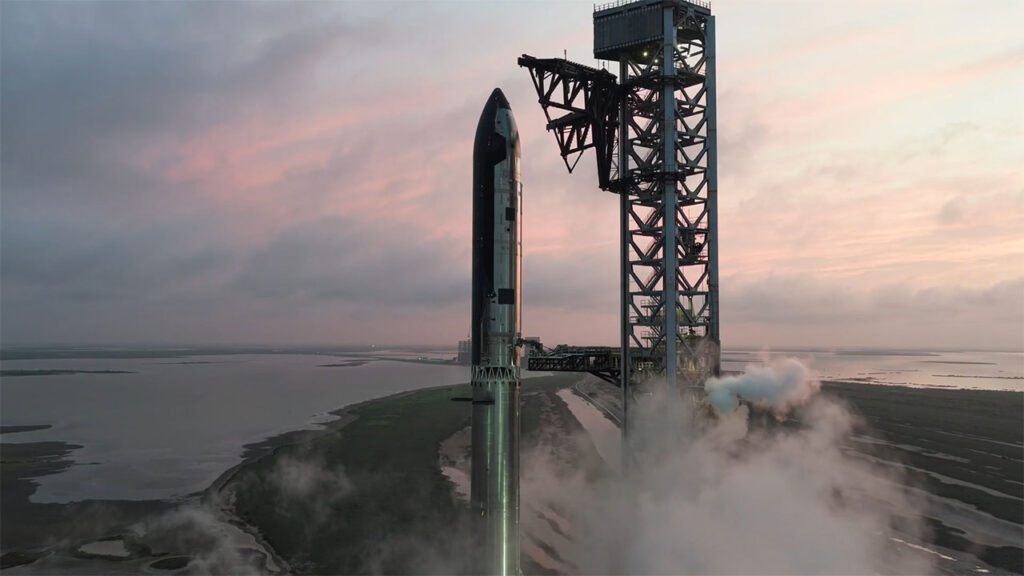
Elon Musk’s X post confirming the original schedule of Starship Flight 13.– Advertisement –A fully stacked Starship V3 at Starbase Mechazilla launch tower. Credit: SpaceX / X.
The Road to Starship Flight 13
After the partial failure of the Flight 12 Starship launch, SpaceX quickly moved on to the next Starship launch test. The preparations for the Flight 13 Starship were already ongoing even before Flight 12.
SpaceX assigned Super Heavy Booster 40 as the 1st/lower stage rocket and Starship 40 (Ship 40) as the upper-stage spacecraft. In the Flight 13 test (IFT-13), both vehicles have their own objectives (detailed below).
Ship 40 Preparation
Ship 40 went through two cryogenic pressure-proof tests in May. In June, SpaceX performed an engine igniter test on the Flight 13 upper stage. These were preliminary tests before the major static fire tests.
On Friday, June 26, SpaceX conducted a single-engine static fire test on Ship 40. After around a week, on July 2, Ship 40 went through a 6-engine static fire test. SpaceX shared the following footage of this intense test performed on a static fire test stand at the Massey’s Outpost, Starbase, Texas.
Flight 13-Super Heavy Booster 20 went through two cryogenic pressure-proof tests on June 7 and June 8 consecutively. Interestingly, Booster 20 got a holiday from major testing for about a month.
On Friday, July 10, SpaceX directly conducted a 33-engine static fire test on Booster 20. The success of this test made the booster flight-ready for the upcoming launch (watch below).
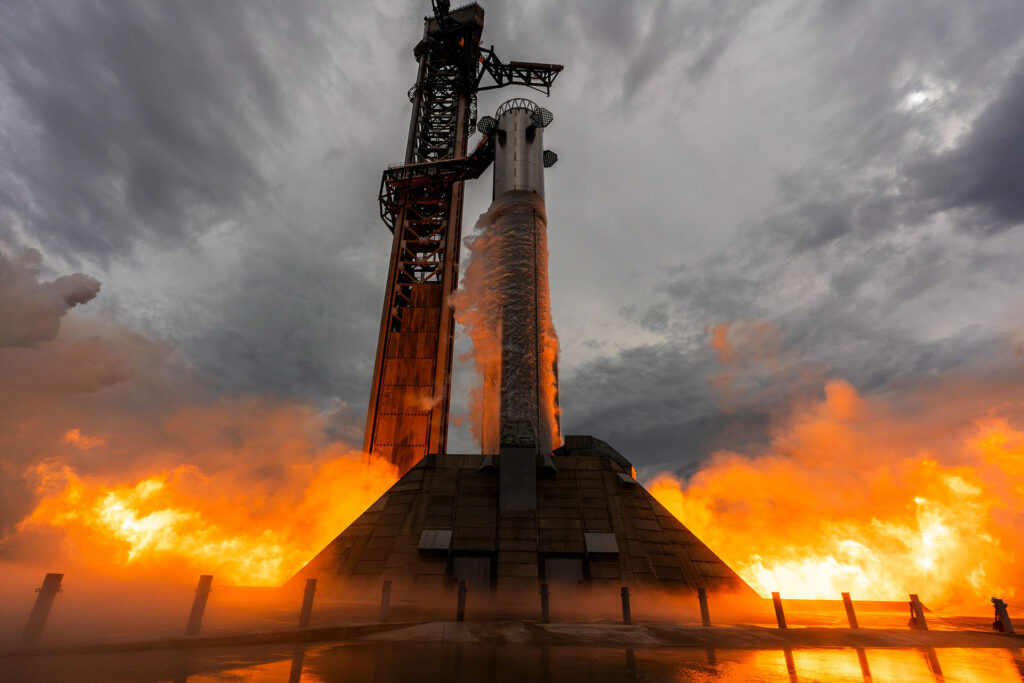
– Advertisement –The flame trench deflects the heat and flames as Booster 20 goes through a 33-engine static fire test at Starbase, Texas, on July 10, 2026. Credit: SpaceX / X.
Starship Flight 13 Objectives
Since SpaceX couldn’t fully achieve its objectives with the Flight 12 Starship launch test, the space company aims for similar objectives with Flight 13.
To mitigate Flight 12 issues, SpaceX has made several upgrades and improvements to multiple systems. Flight 13 launch will also provide valuable data for thermal protection as the Starship is equipped with thousands of heat shield tiles.
Booster 20 Objectives
In the official update, SpaceX defined the Booster 20 objectives for Flight 13 as:
The booster’s primary test objective will be executing a successful launch, ascent, stage separation, boostback burn, and landing burn at an offshore landing point in the Gulf of America. There have been several modifications to hardware and software to address issues seen on the previous flight.
At stage separation on Flight 12, slight differences in engine startup on the ship caused the directional flip of the booster to be off by approximately 90 degrees. The startup sequence has been modified to be more robust to timing variability and more reliably flip in the desired direction, which is done to increase overall performance.
– Advertisement –
After stage separation and the flip, the Super Heavy booster attempted its boostback burn. Five of its 33 engines experienced issues when attempting to re-light causing the boostback burn to end early. The Super Heavy on this upcoming flight has hardware modifications to improve re-light reliability along with updates to engine alarms and aborts to match the conditions seen in the multi-engine flight environment.
Starship 40 Objectives
SpaceX defined the following objectives for Starship 40 in the Flight 13 test:
The Starship upper stage’s primary objectives include the deployment of 20 Starlink V3 satellites, a relight of a single Raptor engine while in space, and another controlled entry, descent, and splashdown in the Indian Ocean. There have also been several modifications to Starship’s propulsion system to address the engine out issue experienced on the previous flight.
Starlink V3 Deployment in Space
Interestingly, SpaceX will attempt to deploy 20 Starlink V3 satellites in space for the first time in the Flight 13 test.
The Starship upper stage’s primary objectives include the deployment of 20 Starlink V3 satellites, a relight of a single Raptor engine while in space, and another controlled entry, descent, and splashdown in the Indian Ocean. There have also been several modifications to Starship’s propulsion system to address the engine-out issue experienced on the previous flight.
For the first time, Starship will carry V3 Starlink satellites to space, which aim to greatly expand the network’s capacity and user speeds. As part of this initial test, Starship is planned to deploy 20 satellites which will extend solar arrays and antennas and will attempt to connect with the larger Starlink constellation via high-capacity lasers. The Starlink satellites will be on the same suborbital trajectory as Starship and are expected to demise upon reentry approximately 20 minutes after deployment.
Six of the satellites have been modified with a suite of cameras to scan Starship’s heat shield and transmit imagery down to operators to continue testing methods of analyzing Starship’s heat shield readiness for return to launch site on future missions. Several tiles on Starship have been painted white to simulate missing tiles and serve as imaging targets in the test.
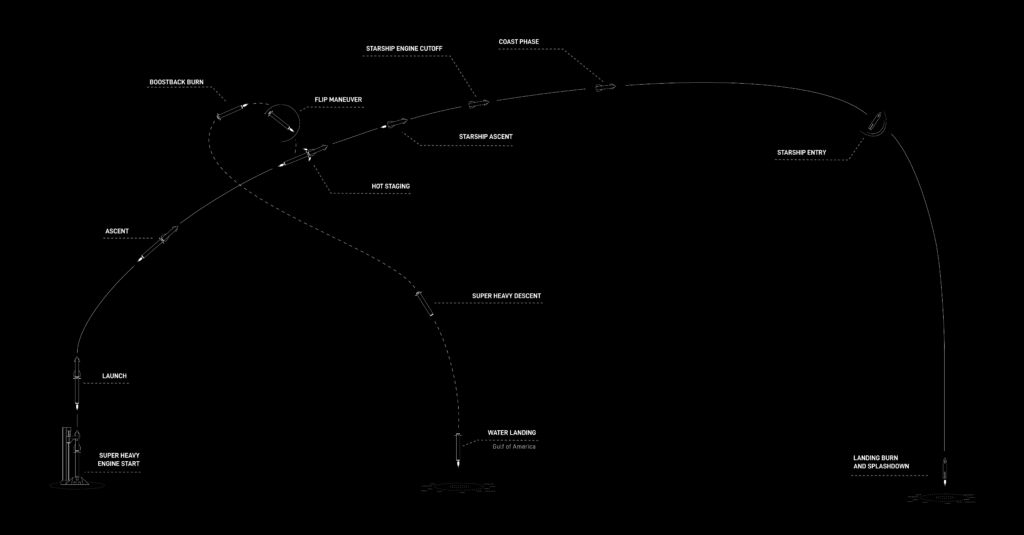
Diagram of the Starship Flight 13 launch and landing test trajectory and objectives. Credit: SpaceX.– Advertisement –
Author of more than 1500 articles on Tesla, SpaceX, and EVs. His work has been liked and tweeted by Elon Musk and other prominent influencers. You can reach him on Twitter @IqtidarAlii