Tesla (NASDAQ: TSLA) stock rose 2.73% in the last 5 business days. Cybercab’s unprecedented success and critical acclaim, coupled with Slovenia’s approval of FSD (Supervised), were the major factors.
Some critics say Cybercab’s Austin, Texas, launch is Tesla’s iPhone moment. The company’s CEO originally wanted the Tesla Model 3’s launch to be that moment, but production hurdles and Tesla FSD delays spoiled his plans.
Around 9 years later, Musk’s dream is finally becoming a reality. Although the automaker has achieved great success in delivering millions of vehicles around the globe, the wow moment hadn’t happened before the Cybercab launch.
The keyword ‘Cybercab’ reached the maximum popularity index of 100 on Google the day after its launch (September 4). Surprisingly, interest isn’t coming only from the United States or the Western world. The top Asian countries searching for Cybercab include China, Taiwan, and Hong Kong (see the graph screenshot below).
As a competitor to the US in technology and AI, China is extremely focused on staying ahead in the self-driving race. Tesla Cybercab gives the Chinese automakers another challenge, deploying a truly driverless unsupervised robotaxi.
The Tesla Cybercab is basically the modern-day version of an elevator.
— Teslaconomics (@Teslaconomics) September 10, 2026
Except instead of taking you up and down floors… it takes you wherever you want to go.
You get in.
Press a button.
And it takes you there.
That’s it.
I think Tesla landed on a MAJOR hit product. pic.twitter.com/7DnRI1Laap
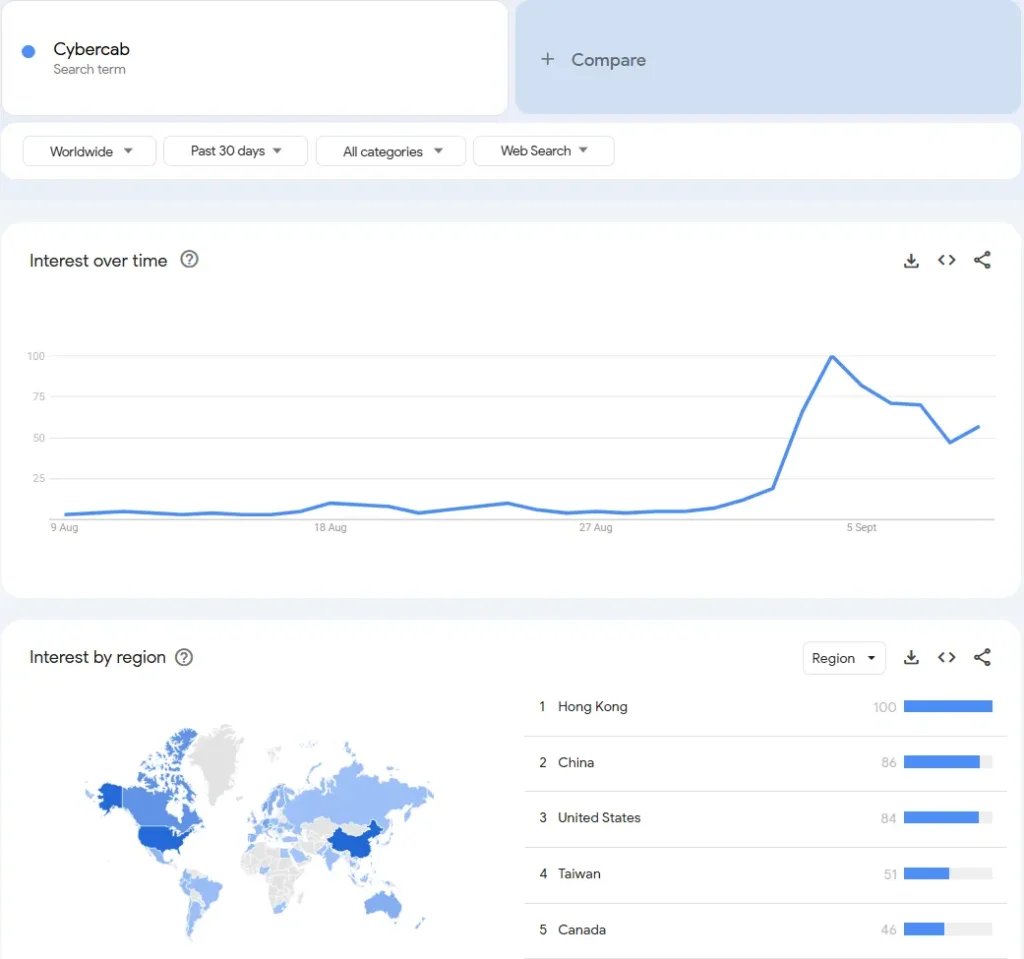
The Cybercab interest graph peaked on September 4, but the interesting part is that interest hasn’t dipped completely since then. As the graph shows, the term’s popularity is holding steady at a median level compared with the low interest seen in August.
Cybercab’s Efficient and Low Cost of Production
Cybercab is Tesla’s most disruptive product yet. In some cases, it will likely disrupt Tesla’s own vehicle lineup in the future. The electric-vehicle maker has already discontinued the Model S and X vehicle lineup to focus on the Optimus humanoid robot and the Cybercab.
Unboxed Process: Modular Vehicle Assembly
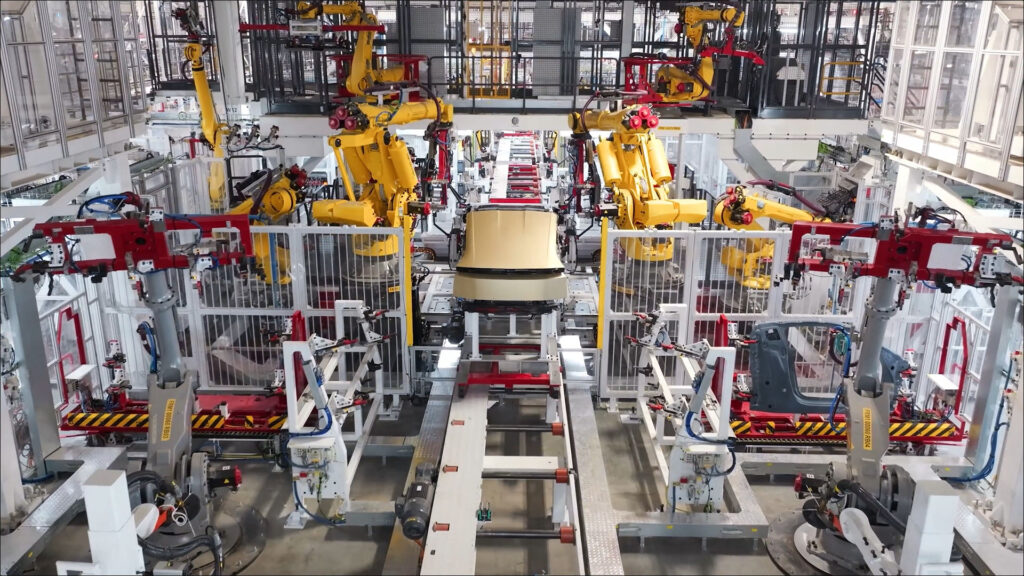
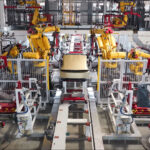
Yesterday, Tesla shared the following short video from Giga Texas, where it manufactures the Cybercab. The automaker has developed a new technique for manufacturing the Cybercab. It’s made in modules.
For example, the following photo from the Cybercab Giga Texas production line shows the vehicle’s entire front module. This module includes the front trunk, suspension, and its frame, developed separately. Similarly, there’s another module that includes the cabin and rear end of the vehicle.
Later in the production process, the industrial robots assemble the main vehicle modules together (front and center-back). Finally, they attach doors and body panels on both sides to complete the vehicle.
Tesla calls this the “Unboxed Process”. According to the automaker, this production technique reduces the production line by half.
Interestingly, Tesla compares this 50% reduction to its own highly optimized production processes, not to traditional automakers producing ICE cars or EVs.
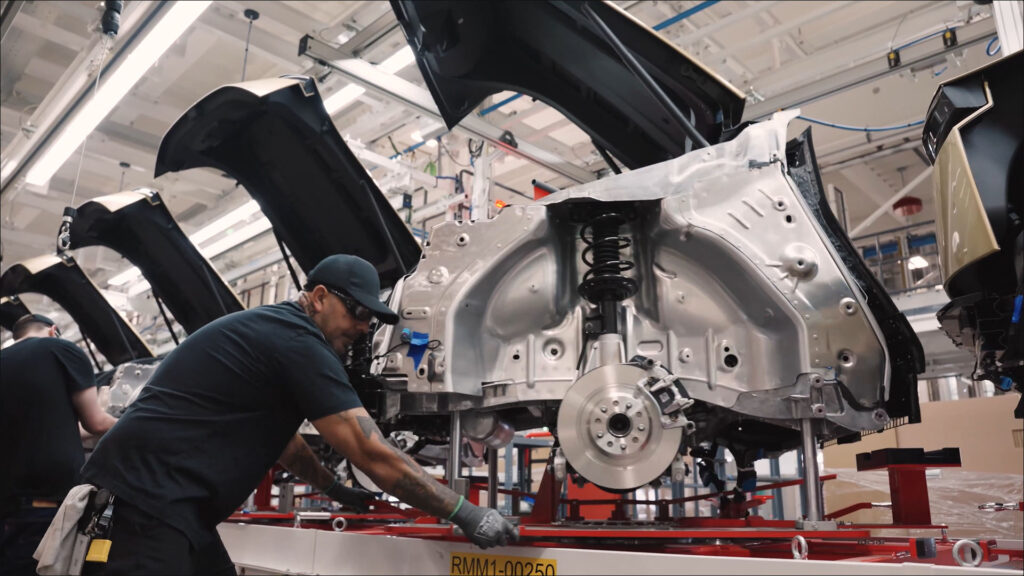
Our unboxed process for Cybercab assembles vehicle modules in parallel & frames the car in one step at the end.
— Robotaxi (@robotaxi) September 8, 2026
This streamlines automation & reduces the line size by half, unlocking much greater production capacity.
The first real revolution in automotive manufacturing in over… pic.twitter.com/AbOCFCKM9D
Tesla explains this process as:
Our unboxed process for Cybercab assembles vehicle modules in parallel & frames the car in one step at the end.
This streamlines automation & reduces the line size by half, unlocking much greater production capacity.
The first real revolution in automotive manufacturing in over a century.
Lower Cost of Production: Absence of Steering Wheel, Pedals, and Stalks
The absence of a steering wheel, brake and acceleration pedals, and any stalks makes the Cybercab more cost-effective to produce. Coupled with the Uboxed Process module vehicle assembly, the Tesla Cybercab is apparently the most cost-effective vehicle to produce.
A considerable reduction in the number of components and their related mechanical, electrical, and electronic parts also reduces production time. Tesla also does not have to deal with many suppliers to procure these parts, resulting in significantly fewer supply chain constraints.
On the software side, Tesla is also fully independent of any other tech company. Tesla Cybercabs currently use FSD (Unsupervised) v15 AI-vision-based self-driving technology, built and maintained in-house by Tesla.
Fewer parts, less time, and technological independence put Tesla in an ideal position to scale Cybercab production at massive scale in the near future.
The current fleet is completely Tesla-owned. However, the automaker plans to put the Cybercab up for sale before the end of this year. And interestingly, Tesla CEO Elon Musk has a bet with non-believers on this as well.
Tesla aims to launch Cybercab for sale at $30,000 or less. This will make it the most affordable autonomous vehicle that customers can own, and even small companies can operate a fleet for profit.
Tesla Cybercab Competition
In the United States, Tesla Cybercab has two direct competitors in the autonomous robotaxi market, Waymo and Zoox.
From a production and cost-efficiency perspective, Waymo is far behind Tesla. Waymo uses an already expensive Jaguar I-Pace as the base vehicle. On top of that, Waymo installs lidar, a ton of radars, cameras, and sensors for safety. This makes producing these vehicles at scale very costly.
Waymo was launched to the public in October 2020. According to NHTSA, Waymo operates a fleet of 3,871 vehicles in the US as of this writing. This is the scale Waymo has achieved in the last 6 years.
Zoox, on the other hand, has just completed its one year of trials on the Las Vegas Strip today (September 10). Zoox only has 100 to 105 robotaxis on the road.
Zoox’s Hayward, California factory can scale production up to 10,000 robotaxis per year. But does Amazon have Full Self-Driving (FSD) AI vision software as good as Tesla’s? The simple and plain answer is a big No.
Amazon’s Zoox will hit a roadblock as it scales its robotaxi service across cities and will face road-safety and regulatory hurdles.
Tesla’s Cybercabs, on the other hand, are swarming in different US cities, showing the automaker’s intent to launch on a massive scale in the near future.
Perhaps Amazon should use Tesla’s FSD to succeed in this area, but I think Jeff Bezos won’t agree. Let us know your thoughts on this in the comments section below.
Stay tuned for constant Tesla updates. Follow us on:
Google News | Flipboard | X (Twitter) | WhatsApp Channel | RSS (Feedly).
Related News on Tesla Cybercab
- Tesla scales Cybercabs in Texas and halts the number of Model Y Robotaxis
- Tesla Robotaxi and Cybercab fleet in Texas surpasses the 500 mark (420 + 126)
- Large number of Tesla Cybercab robotaxis spotted in Houston, hinting at a launch soon
- First responder training and feedback enhance Tesla Cybercab crash and fire safety
- Tesla Cybercab is the most cost-efficient vehicle to produce, competition doesn’t stand a chance
- High demand for Tesla Cybercab makes it more expensive than Uber and the Model Y Robotaxi