

Tesla (TSLA) is making fast, small iterations to the FSD v14.3.4 with point releases to its firmware. Tesla started the rollout of FSD v14.3.4 with the 2026.14.6.10 update before mid of June.
In the following days, Tesla rolled out the 2026.14.6.11 update but still kept the FSD version to 14.3.4. On 23rd June, the tech & AI-based automaker once again released a new subversion point release update 2026.14.6.12.
These subversions of the FSD v14.3.4 update don’t mention any major changes in the release notes. However, as Tesla owners are getting these new updates one by one, the improvements or regressions are clearly noticeable (see first impressions below).
Interestingly, Tesla now has three versions of FSD being simultaneously rolled out in three regions. FSD in Europe is on v14.2.2.6 (2026.17.5), and FSD in Australia is on FSD v14.3.3 (2026.16.6).
The FSD v14.3.4 with firmware versions 2026.14.6.11 and 2026.14.6.12 are for the North American region.
Rollout Status
Data from Tesla software update tracking websites, TeslaFi.com and Tessie, reveal that most FSD users in North America are currently on the 2026.14.6.11 update (this version is now phasing out).
Although it has been a few days since the new 2026.14.6.12 update started rolling out, the rollout wave has slowed down after it went up on June 24.
As of this writing, only around 0.4% of the Tesla fleet has received the FSD v14.3.4 (2026.14.6.12) update. Tesla might have decided to stop the rollout of this release due to possible regressions (some have been noticed by Tesla owners, see below).
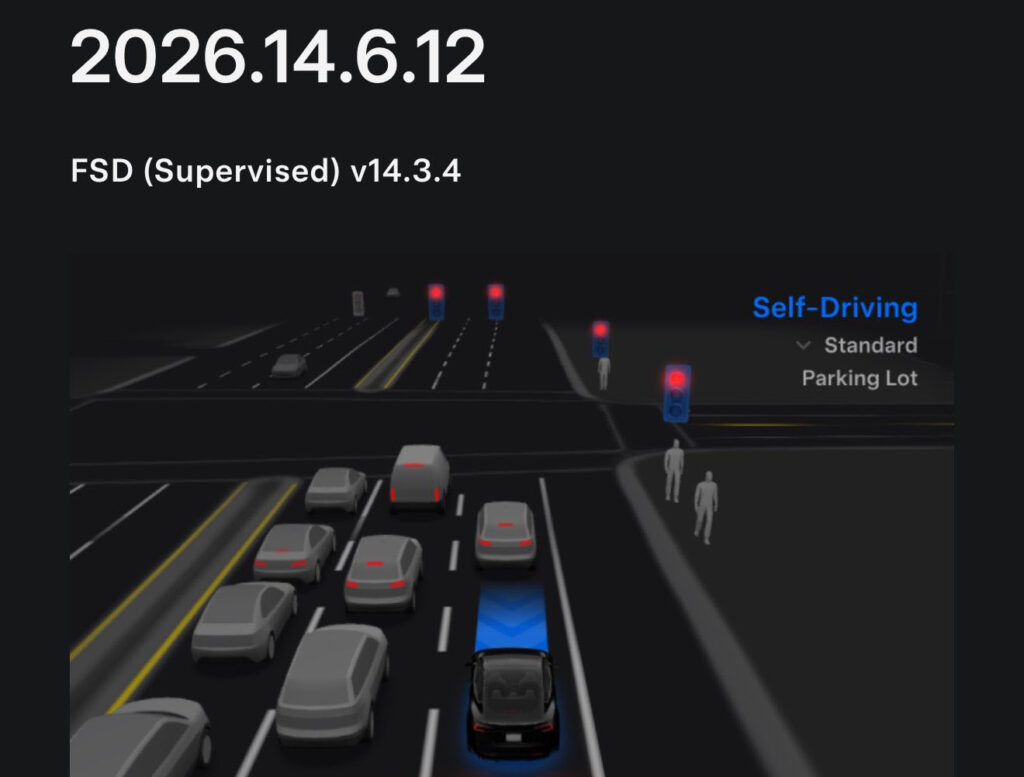
FSD v14.3.4 (2026.14.6.12): First Impressions (videos)
A Tesla owner shared his experience with the new FSD v14.3.4 (2026.14.6.12) update in the following words:
Tesla’s 2026.14.6.12 update with FSD 14.3.4 feels like one of those “small numbers, big difference” releases.
Lane changes are way smoother now, less hesitation, more clean decisions instead of that awkward “should I, should I not” moment. It just picks a gap and goes.
Parking is also noticeably better. It seems more confident about where it’s actually trying to end up, so fewer weird corrections at the last second and less circling around like it’s overthinking it.
And the biggest win for me is the reduced stab braking. Way less of that random quick brake tap feeling, especially in normal traffic flow. It’s just smoother and more steady overall.
Not a flashy update, but it definitely makes everyday driving feel more relaxed.
Tesla’s 2026.14.6.12 update with FSD 14.3.4 feels like one of those “small numbers, big difference” releases.
— Digital Daisy🌸 (@DigitalDaisyX) June 25, 2026
Lane changes are way smoother now, less hesitation, more clean decisions instead of that awkward “should I, should I not” moment. It just picks a gap and goes.
Parking… pic.twitter.com/dD8vFuxnx2
Another owner wrote (the video is only available on X):
2026.14.6.12 is much more jumpy than .11. It was more confused at this turn out this time than ever before under .11 and before.
FSD v14.3.4 (2026.14.6.12) Official Release Notes
Full Self-Driving (Supervised) v14.3.4 includes:
- Upgraded the Reinforcement Learning (RL) stage of training the FSD neural network, resulting in improvements in a wide variety of driving scenarios.
- Upgraded the neural network vision encoder, improving understanding in rare and low-visibility scenarios, strengthening 3D geometry understanding, and expanding traffic sign understanding.
- Rewrote the AI compiler and runtime from the ground up with MLIR2, resulting in 20% faster reaction time and improving model iteration speed.
- Mitigated unnecessary lane biasing and minor tailgating behaviors.
- Increased decisiveness of parking spot selection and maneuvering.
- Improved parking location pin prediction, now shown on a map with a (P) icon.
- Enhanced response to emergency vehicles, school buses, right-of-way violators, and other rare vehicles.
- Improved handling of small animals by focusing RL1 training on harder examples and adding rewards for better proactive safety.
- Improved traffic light handling at complex intersections with compound lights, curved roads, and yellow light stopping – driven by training on hard RL examples sourced from the Tesla fleet.
- Improved handling for rare and unusual objects extending, hanging, or leaning into the vehicle path by sourcing infrequent events from the fleet.
- Improved handling of temporary system degradations by maintaining control and automatically recovering without driver intervention, reducing unnecessary disengagements.
- Unified the model between Actually Smart Summon, FSD, and Robotaxi for more capable and reliable behavior.
- Actually Smart Summon max speed is now increased to 8mph (13km/h).
- Help Tesla improve Self-Driving by selecting an intervention reason on the main screen after taking over.
- You can now see distance traveled in FSD (Supervised) without an intervention. The Self-Driving App will also show your longest intervention-free streak.
Upcoming Improvements
- Expand reasoning to all behaviors beyond destination handling.
- Add pothole avoidance.
Acronyms used:
- RL = Reinforcement Learning
- MLIR = Multi-Level Intermediate Representation (MLIR)
- FSD = Full Self-Driving
- AI = Artificial Intelligence
Stay tuned for constant Tesla updates. Follow us on:
Google News | Flipboard | X (Twitter) | WhatsApp Channel | RSS (Feedly).
Related Tesla FSD News
- Tesla rolls out FSD v14.2 Lite: legacy Tesla owner reviews, rollout status
- Tesla rolls out FSD v14.3.9 (2026.27.6) with Automatic Collision Evasion: feature details and official release notes
- Unsupervised Tesla Cybercabs roam the streets of Austin ahead of launch (videos)

- Tesla merges FSD v14.3.8 and the Summer Update (2026.26.6.5), Grok voice commands gain more control
- Tesla rolls out FSD v14.1 Lite after HW3 ECU overheating issues in FSD v14 Lite
- Tesla FSD v14.3.7 fixes regressions found in the previous version (video reviews)


 starts the rollout of the 2026.14.6.12 (FSD v14.3.4) software update. Watch and read the first impression reviews, get the release notes, and rollout status.)