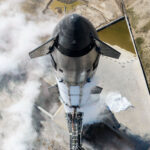
SpaceX CEO and Chief Engineer Elon Musk had tweeted last night that a Starship SN11 high-altitude flight test is possible this morning. The spaceship prototype was tested but almost no one saw what happened, especially on landing.
All camera views except the ones installed on the Starship SN11 itself were blurred due to the thick Texas fog that covered the entire Starbase Boca Chica launch facility today.
The SpaceX official SN11 flight launch live-stream webcast was halted as soon as the landing burn was triggered, the on-board camera feed was also lost. This might have happened due to the RUD (rapid unscheduled disassembly) of Starship SN11.
This was the 4th Starship high-altitude test performed by SpaceX. The SN11 test flight was scheduled for yesterday but was scrubbed (canceled) due to the decision of the Federal Aviation Administration (FAA).
Elon Musk suspects that Raptor Engine #2 on SN11 likely had some issues on the ascent and was not able to reach the operating chamber pressure during the landing burn. SpaceX has started investigations into the major issue that resulted in SN11 RUD shortly after the landing burn.
Looks like engine 2 had issues on ascent & didn’t reach operating chamber pressure during landing burn, but, in theory, it wasn’t needed.
Something significant happened shortly after landing burn start. Should know what it was once we can examine the bits later today.
Source: Elon Musk on Twitter

The catastrophe aside, these test flights are purely for learning purposes — SN10 and 11 and have provided vast amounts of good test data to SpaceX. This information is going to come in handy for launching and landing the next Starship prototypes, next in line is the Starship SN15.
After today’s SN11 flight test, Musk took to Twitter and said that SN15 will be rolling out to the launch pad in a few days with major design, software, avionics, and engine improvements.
SN15 rolls to launch pad in a few days. It has hundreds of design improvements across structures, avionics/software & engine. Hopefully, one of those improvements covers this problem. If not, then retrofit will add a few more days.
Elon Musk on Twitter
However, Musk iterates that the Starship SN20 prototype will have major technological revisions applied to it. He further disseminated the following information about SN20:
Next major technology rev is at SN20. Those ships will be orbit-capable with heat shield & stage separation system. Ascent success probability is high.
However, SN20+ vehicles will probably need many flight attempts to survive Mach 25 entry heating & land intact.
Elon Musk on Twitter.
Related: Watch the Starship SN11 flap actuation test that looks like a dance | SN11 first static fire test (video)
Stay tuned for future updates on Starship and SpaceX. Follow us on:
Google News | X (Twitter) | Flipboard | WhatsApp Channel | RSS (Feedly).
Related
- Flight 15 catch, Starlink V3, SI ($1T revenue): Key takeaways from Elon Musk’s SpaceX (SPCX) Q3 2026 Earnings Call
- Elon Musk to give a share of SpaceX (SPCX) to every American child, President Trump praises the act, more

- Starship 40 joins three other ships inside SpaceX’s Megabay at Starbase, it’s time for some serious data collection
- Flight 13 Starship 40 returns home to Starbase, Texas, after months at sea
- SpaceX deployed 26 terabits per second of Starlink V3 bandwidth in a single Starship launch (Flight 14)
- Watch Flight 14 Starship launch live stream recordings and read the live updates archive